CityDashBoard TalesofThings MapTube
Qrator Tutorials About Digital Urban
MRes ASAV SurveyMapper Contact Us

2007-04-28

Book Review - Wikinomics


The last couple of years or so has seen a sea change in social spaces, collaborative informational spaces and mass sharing of media on the web, in short the web has come of age. As such Wikinomics is timely, examining the rise of sites such as Second Life, MySpace and Wikipedia, amongst others.

Partly marketed as a management book it is in fact a good general read and almost essential reading for anyone involved in the area of social, virtual or new media spaces. Based on a 9$ million research project, Wikinomics shows how masses of people can participate in the economy like never before.

The books comes highly recommend and as mentioned essential for anyone researching, involved in, or thinking of starting their own collaborative space.

You can purchase it, currently at discount, via our associate store at Amazon along with other books on our recommend reading list.

2007-04-27

South Pacific Railway Panorama

On a drive out of San Francisco, on route to the Napa Valley, we came across an abandoned train which turned out to be part of the South Pacific Coast Railroad.

Wikipedia describes the railway as -

"a 3 ft (914 mm) gauge narrow gauge steam railroad running between Santa Cruz, California and Alameda, with a ferry connection in Alameda to San Francisco. The railroad was created as the Santa Clara Valley Railroad, founded by local strawberry growers as a way to get their crops to market in San Francisco and provide an alternative to the Southern Pacific Railroad. In 1876, James Graham Fair, a Comstock Lode silver baron, bought the line. He extended the line into the Santa Cruz Mountains in order to capture the significant lumber traffic coming out of the redwood forests.

In 1887, the line was acquired by the Southern Pacific and the gauge standardized. In later years, the segment running between San Jose and Santa Cruz was used by SP's "Suntan Special" which came down the San Francisco Peninsula and took passengers right to the beach and boardwalk in Santa Cruz. Service was disrupted by the 1906 Earthquake[1]. The tracks through the Santa Cruz Mountains suffered major damage during a storm in the winter of 1940, and the line was abandoned the same year."

The panorama was captured in High Dynamic Range giving it a slightly unreal look:


We dont normally tweak our panoramas but this scene works well in sepia - providing a slighly surreal look at the old South Pacific Railroad:

You can view both the High Dynamic Range panorama (3.62Mb) in Quicktime Virtual Reality and the Sepia Version (3.31Mb).

2007-04-26

How to Geotag Photographs on the Nokia N95 for Google My Maps and Flickr


Its taken a bit of time to work this one out but with a few simple steps you can capture geotagged photographs on your Nokia N95, upload to Flickr and then add them to Google's My Maps.

The process is simple:

Initial Set Up

1) First off go to ShoZu.com - Shozu is freely available software that allows you to both geotag photographs on your N95 and upload to a number of online services, in our case Flickr.

Sign up with the site and select the Nokia N93 as your phone (the N95 is not yet listed). You will be asked to set up a user name and password as well as your mobile number. Once registered ShoZu will send a text along with a link to download the software. We downloaded via a Wi-Fi link to make sure we didn't incur any phone charges;

2) Install ShoZu on your N95 and login to your account using the username and password you set up. This will authenticate your account allowing you to log back into the web based service and set up a number of destinations to upload your photographs;

3) To enable uploading to Flickr go to the web page and selecting the 'Share It' tag. Now simply go through the process of allowing ShoZu the required rights to upload to your account.

This completes the set up ShoZu in terms of services, we now simply need to turn on GPS tagging;

4) Open ShoZu on your N95 and go to: Options/View and then the images tag which is indicated by a film strip icon. The 4th option is GPS Tagging, switch this to On.

Capturing and Uploading

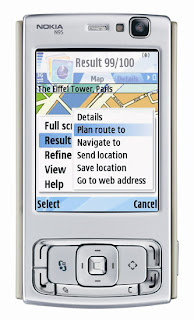
1) Open either Nokias 'Maps' or the 'Sports Tracker' application and make sure you are getting a GPS fix, we use Sports Tracker as it allows us to additionally upload our route to Google Earth/Maps;

2) Start taking your pictures, with ShoZu installed each photograph will have a location tag written into its EXIF information.

3) Open ShoZu and select Share-It/All files, this will display a list of your photographs. Select the image your want to upload and click Options, this displays the choice to Send to Flickr. Select send and your image will be uploaded, again we uploaded via Wi-Fi to minimise any data charges.


Your images will now be available on your Flickr page and automatically geotagged. Within Flickr you can choose to view by map which opens a Yahoo Map page, we prefer Googles My Maps options:


1) At the bottom of your Flickr Photos page you will see a RSS Feed Icon and the Feed link - Right click on this link and copy the link location;

2) Login into your Google Maps account and paste the feed location into the search box - now add the following to the end of the paste '&georss=true' (without the ')

3) Running the search will display your photographs from the N95 on Google Maps via Flickr, to add them to My Maps simple click on each icon and choose 'Save to My Maps'

You can view our geotagged images from the Nokia N95 on our My Maps page.

2007-04-23

Updates..

At the moment we are working on a walk through to geo-tag your photographs with a Nokia N95. This should be ready tomorrow - we can't try it yet as our battery has just gone flat - but we are confident it will work.

Still getting back into things at work but news on the AAG conference, Google Earth and Microsoft Live to follow soon as i have time to post...

Also an update of the RealViz Stitcher review is on its way as well as that Oblivion tutorial...

2007-04-16

Spatial Technology Gallery - Digital Urban at the AAG


It took a visit to Franks Google Earth blog and then onwards to Alan's Geography 2.0 Virtual Globes to find out the details - we will be showing work at the Spatial Technology Gallery, a special event at the 2007 Association of American Geographers Annual Meeting.

Details taken from Geography 2.0 are:

When:
Wednesday, April 18, 2007, 7:00pm-9:00pm,

Where:
Conference Room Yosemite B, Hilton San Francisco, located at 333
O'Farrell Street San Francisco, CA 94102 -View Location on My Maps.

What:
On Wednesday evening, a select group of researchers from academia, government labs, and industry have been invited to demonstrate their latest, cutting-edge spatially-enabled technologies. The format will be simultaneous demos--a mix of science fair, test drive, and show-and-tell. This organic event will provide an opportunity to examine and discuss the technology and incubating ideas that will be impacting in coming weeks, months, and years, with the pioneering minds that are making them. We anticipate topics spanning virtual globes, augmented reality, open source mapping projects, internet GIS, environmental simulation and prediction, map mashups, and mobile spatial data collection.

This "after hours" event is open to anyone interested in spatial technology, so you will not need to register for the AAG meeting to attend. If you want to participate in any other aspects of the AAG meeting, however, you would need to register and pay like normal.


Who:
--ESRI
--Microsoft
--NASA World Wind
--Urban Mapping LLC
--CASA University College London
--Center for Fire Research and Outreach (Berkeley)
--UCSB Center for Nanotechnology in Society and UCSB Geography
--Dave Lemberg (Western Michigan)
--Jesse Rouse and Sue Bergeron (WVU/Very Spatial)
--Johannes Schoening (Muenster)
--Brian Tomaszewski (Penn State)
--Dawn Wright and Andre Skupin (Place and Spaces Project)
--Chuanrong Zhang (Kent State)

NSF/ESRC Agenda Setting Workshop on Agent Based Modelling of Complex Spatial Systems - Day 2

Day two at the NSF/ESRC Agenda Setting Workshop on Agent Based Modelling of Complex Spatial Systems in Santa Barbara.

Currently presenting is David O'Sullivan, ex of our lab at CASA.

Agent-based complex systems are dynamic networks of many interacting agents; examples include ecosystems, financial markets, and cities. The search for general principles underlying the internal organization of such systems often uses bottom-up simulation models such as cellular automata and agent-based models -Grim et al 2005.

Complex systems are irreducible - a compact model of a complex system is possible. In general, specific to complex systems is the interest in the spatial locations of the outcomes, such as patterns, processes and the relationship between them.

Verification of any model of an open system is impossible and validation is not the same thing. In a similar fashion, calibration and confirmation are also not the same thing (as verification, or as one another), the argument therefore is for multiple models.

We therefore know that the end product is difficult to analysis and therefore do the models merely outcome what we expect? Keith Bevan has a proposal for a coherent philosophy for modelling the environment, while Steve Bankes advocates working with multiple models.

Agent Based Models models play multiple roles throughout the scientific process, as such it is hard to pinpoint the nature of the exploration. It is also of note that real world choices are made depending on the outcomes of models.

The talk ends with a series of questions - What type of science is Agent Based Modelling? Are tools making the problem work or can they be part of the solution? Does GIS have a role to play?

I would add that it needs to be asked why is the tool set is so complicated? The role of GIS and agents was demonstrated yesterday by ESRI and the level of complexity is concerning, as is the quality of the visualisation.

Interestingly, people do not seem to be aware of the type of model systems running in current game engines and therefore wth full 3D visualisation....

******

Next up is Dawn Parker of George Mason University looking at what researchers seek from Agent Based Models. In general is it a better understanding of the process behind real world systems. Yet models are complex, should they be simplified?

Take a look at Dawn's SLUDGE model (Simulated Land Use Dependent on Edge Effect Externalities). SLUDGE is a simle combined cellular automaton and agent-based model designed to study the joint influcent of distance-dependent spatial externalities and transportation costs on patterns of land use.

******

Coffee Break :) - For a full rundown on GIS and Agents see the CASA GIS and Agent Based Modelling Blog.

2007-04-15

Nokia N95 Tracking from San Francisco to Santa Barbara

We have run a couple of posts recently on the GPS functionality of the Nokia N95, most notably using the Sports Tracker application to track a train in London. We continue this theme, this time tracking our 5 hour drive from San Francisco to Santa Barbara, California.

The interesting issues here are firstly the time covered - 5 hours - presenting an interesting spatial/temporal visualisation and secondly the fact that Sports Tracker was used at the same time as the general mapping application.

Previously we had used Sports Tracker as the main application, thus losing the ability to navigate as the tracker does not yet include a general map overview. To solve this you can set Sports Tracker running and then continue to use the phone for any other use, in our case general GPS navigation.

The ability to run tracker in the background means that you can view the map secure in the knowledge that your speed and route is being logged for later visualisation in Google Earth.

With a top speed of 137km/h and covering 508km you can view our entire route in Google Earth

NSF/ESRC Agenda Setting Workshop on Agent Based Modelling of Complex Spatial Systems

Sitting in the Upham Hotel, Santa Barbara at a two day workshop on Agent-Based Modelling.

An interesting day of presentations ahead including a look into representations of complex modeling and a demonstration from David Maguire of ESRI.

Depending on the relevance we will update this post with details and thoughts..

First up is Mike Worboys, University of Maine looking into the technology which is driving effective agent based modelling.

Technology is weaving itself into everyday life until it becomes part of the general human experience, with each new innovation comes new challenges for modelling systems. Temporal progressions infer changes but we often miss occurrent entities and their relationships when developing models....

Distributed models are inherently complex, even if described by simple rules. Rule systems are not enough we need more 'mathematical' principles upon which such systems can be expressed. Credo: Process algebras and their extensions that handle mobility provide a possible next step from cellular rules.

Following on is Marina Alberti from the University of Washington on Modelling Complex Urban Landscape Dynamics: A Pattern-Orientaed Approach. Take a look at the research site for papers and details.

Agent based models are being used at Washington to model emerging phenomena resulting from the interactions of individual entities. Their agents exhibit complex behaviour and learning algorithms based on a hierarchical model.

Dynamic Probabilistic Relations Models (DPRM) are a particular type of nth order Markov model allowing for representation of different types of states and complex relations -each relation is described by its own set of variables. Washington's Bio-complexity Conceptual Model is structured with demographic and a micro simulation of human behaviour, represented by UrbanSim. The interaction between land user and land cover is driven by a number of spatial interactions.

In general the model provides a probability of the transition of rural/semi-rural to urban areas based on past observations and the generated output.

The discussion is subsequently opened up to the floor moving onto both Activity Theory and emerging phenomena in terms of Complex Systems.

2007-04-13

Union Square San Francisco - Panorama and Make Your Own Cube


We are off to Santa Barbara next week for a conference on Complex Systems and Agent Based Modelling before going onto the AAG at San Francisco.

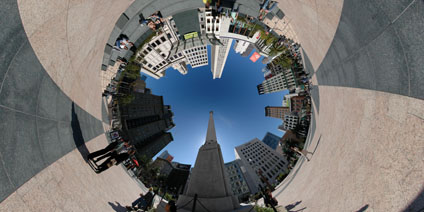
We will be packing our panorama kit but in the mean time pictured above is one of Union Square i prepared earlier...

View the Quicktime panorama of the Union Square San Francisco (2.5mb).

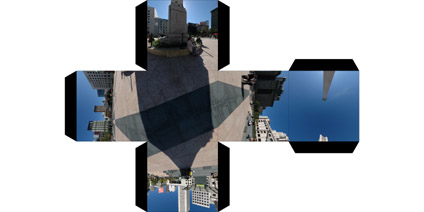
You can also print a cubic version of the panorama to cut out and keep. Simply fold along the edges and glue to create your own 360x180 view of Union Square:


Download the PDF and Cut Out. (4.9mb).

2007-04-12

Embedding Google My Maps and YouTube

A slightly hidden feature of the new Google My Maps service is the ability to embed video directly within the map. Using the 'edit html' option you can simply cut and paste any embed tag from YouTube or Google Video.

The ability to include video, and therefore audio, combined with path overlays lends itself to visualising our Audio and Perception of Urban Space posts.

To recap - Our perception of urban space is based on sight, smell, sound and to some extent touch. Portable music became main stream in 1979 with the introduction of the Sony Walkman and with it came a change to the way we perceive the space around us. By filtering out the natural and man made sounds of the city we are able to immerses ourselves in an alternative reality of our choosing.


The rise of the Ipod has placed this change of perception at our fingertips and the choice of music directly affects the way we perceive the city space. In our example within Google Maps you can view our route taken with audio from the House of Love...

View our Google My Maps with embedded YouTube (click the Audio and Perception of the City layer and then play within the video)

To create your own map go to Google Maps and select My Maps.

2007-04-10

Nokia N95 GPS Google Earth - Tracking a Train

In a follow up to yesterday's post, on the Nokia N95's built in GPS and creating GPS track for visualisation in Google Earth, we thought we would try it out on the train back to Central London.

To be honest we didn't think it would work but as we switched on the GPS, while leaving Wokingham Station in Berkshire, the N95 picked up 6 satellites and displayed our location and speed in realtime. Due to the length of the journey we were not prepared to hold the phone next to the window the whole way so it sat on the seat while playing MP3's and tracking the route.

It performed surprisingly well, only losing the signal at one station which was undercover. While the speed of the train is not something we normally take a great deal of interest in, to see it displayed in realtime is oddly fascinating.


Once the journey was complete we uploaded the route into Google Earth and this time used the altitude of the route to portray speed. This creates an impressive Google Earth path and considering that the phone was merely placed on the seat, rather than near a window, one with a high level of accuracy.

Thanks to the N95 i am now also in possession of some great facts about trains - did you know that on the Wokingham to London Waterloo line the average speed is 60.3km/h or that the maximum speed is 120km/h .........

You can view our path in Google Earth here.

See also iPhone 3G, InstaMapper App and Google Earth: Tracking the Thames Clipper

Digital Urban's Travels - AAG - April 17th-21st

We are attending the Association of American Geographers (AAG) Annual Meeting in San Francisco next week complete with Mike Batty, Paul Longley and Richard Milton of CASA in tow.

At the moment it looks like we are presenting on Thursday evening, if you are coming along and would like to hook up to talk through any ideas etc then let us know.

Before the meeting we are at a conference in Santa Barbara on Agent Based Modelling and Visualisation.

We will be posting a series of updates on the conferences, as well as a return to the series of panoramas on the blog, as long as we can fit the kit into our suitcase..

2007-04-09

Nokia N95 GPS Tracking/Google Earth

We went into Vodafone a couple of days ago after our old Sony phone finally gave up the ghost and came out with a Nokia N95. The N95 has been reviewed on many sites for its various multi-media/wi-fi/photographic abilities but what opened up our thoughts to move over to a Nokia was the built in GPS.

If you own a N95 one of the first things you should do is download the recently released free application 'Sports Tracker' from Nokia. Sports Tracker is aimed at the sports or general user on foot or cycling and more importantly it provides full route tracking with the ability to upload to Google Earth.

The ability to create tracks for Google Earth/Maps in a small portable portable phone is impressive. On our first test run we used the Sports Tracker application on a drive across Berkshire (its meant to be used for running or cycling but it does the same job in a car). The N95 performed well considering it was placed well inside the car, rather than on the windscreen as with most in-car GPS systems. After you have reached your destination you can simply choose to 'Save as Google Earth' and then transfer to your PC.


Once in Google Earth a variety of information points are provided on your travel speed as well as your highest and lowest altitudes. We have only touched on the basic level of functionality here but the N95 GPS comes highly recommended, it is definitely a step forward in Google Earth tracking for the general consumer.

Take a look at our track in Google Earth

See also iPhone 3G, InstaMapper App and Google Earth: Tracking the Thames Clipper

2007-04-08

Up and Coming Posts

Easter Sunday so not much time to post today but a few interesting posts coming up (possibly tomorrow).

Firstly, we will be providing details on the launch of a new multi-user world system that follows in the steps of Adobe Atmosphere. Secondly, we will be looking into the Nokia N95 - a mobile phone that contains built in GPS. Linking it with systems such a Mologogo it should be possible gain real-time tracking via Google Maps/Google Earth.

Real-time tracking is currently viewed as slightly 'stalker-ish', as the comment on our Google Maps post mentions, yet in a few years time it will no doubt become the norm -more on this tomorrow.

Till then Happy Easter

2007-04-05

Mapping Just Got Easier - Google My Maps

Creating your own Google Maps used to be in the domain of people willing to open notepad and hack around with the code while applying for an API key. Google have now made the process a lot easier with the release of 'My Maps'.

The creation process is predictably easy with the ability to add placemarks, icon types, polygons and lines. It was only a few months ago that placing a polygon on the map would of meant dipping into a high powered GIS (Geographic Information Package) and perhaps enrolling on a University course. It is now simply a case of drawing your shape and clicking 'save'.

We have created our first map which you can view here. The map contains a red icon which will act as an update to our current location - think of it as a map based personal Twitter. We haven't worked out how to embed the map into the blog yet as interestingly the Google help files have yet to to be updated.

Once your map is made and shared you can also click on the KML option and view it in Google Earth (thanks to the Google Earth Blog for that tip). Google's My Map may pass slightly unnoticed but it should go down as a defining moment in the ability to produce and distribute maps.

To create your own map go to Google Maps and select My Maps.

2007-04-04

Societies and Cities in the Age of Instant Access

We are on the verge of what many are calling the "second information revolution," based on ubiquitous access to both computing and information. Handheld communication devices will become portable and even wearable remote control devices for both the social and physical worlds. At the same time, access to information will likely flourish, with an explosion in the volumes of data collected and distributed by these new devices—volumes of information about people delivered to more and more people, in new ways. The technologies of instant access have potential to transform dramatically our lives, cities, societies and economies much like the railroad, telephone, automobile and Internet changed our world in the previous ages.

This book contains chapters by leading international experts who discuss issues surrounding the impact of instant access on cities, daily lives, transportation, privacy, social and economic networks, community and education.

Featuring a chapter by Mike Batty and myself entitled 'Imagining the recursive city: Explorations into urban simulacra', Societies and Cities in the Age of Instant Access is a timely book looking at the impact of rapid global communication and information systems on our urban realm.

The book is however $169 dollars which is a high price, mainly it seems that Springer is looking at the library and academic market. We are not sure how this can be justified and it indicates an increasing trend in academia for high book prices. It is in some ways annoying that you write a good book chapter for a strong book only to find it overpriced.

If you can afford it you can purchase it via our Amazon recommended reading list.

Collaborative/Multi-User Google Earth

Last month we reported on Unype.com and their release of an interesting application that links Skype with Google Earth. Linking the two you are able to share Google Earth locations, and therefore collaboratively browse the globe, while talking as per normal via Skype - the linking of Skype and Google Earth is illustrated in the YouTube movie below:


In an update they have now made the application, and thus Google Earth, both collaborative and multi-user with avatar based representation of users. At the moment the avatars doe not move in realtime due to the Google API, but they still allow that important social/avatar linkage to communication.

What maybe more significant is the ability to share models in realtime. If, for example, i am an architect in London communicating to a client in New York we can login to Google Earth via Unype and the client will see on their machines any models that i load into Google Earth.

Its not quite Second Life in Google Earth but its getting there...

Visit Unype to download the application..

One Digital Model per City? - AEC Magazine Article

There is only one London, New York, Tokyo etc yet there are many digital models of each city. London has, at last count, 6 models of varying accuracy and detail, the majority of which are created and held by architecture practices. Investment in the creation of such models can run into six figures and as such the use of highly detailed models are based on commercial licences and restrictive IP. At Digital Urban we hold the view of an open source model allowing the public free access to data and visualisation. It is after all our city and we should have the ability to visualise changes in the public domain. There are of course a number of issues with this point of view, see the recent Guardian Article for more info.

As such we think that their should be a single definitive model of London that architects contribute too and use. Data quality issues would be put in place, compared with say the Google 3D Warehouse, and the model would be held in both Professional GIS, CAD and public access KML formats. Gareth Munro, Managing Director of Designhive refreshingly holds the same view, one which is covered in an article in the March/April edition of AEC Magazine. In an extract from the article Gareth states that:

Almost certainly, whoever has the most detailed and accurate model of London has the competitive edge. The ability to create a 3D model of a building or other development and simply ‘drop it’ into an accurate model of London quickly and efficiently will inevitably win the support, backing and perhaps more importantly the business of architects and developers in the future.

He continues,

However, the creation of multiple London models may provide competitive advantage to some and an instant win for those that ‘have’, but in the long-term does little to save time and cost for architects, developers and the wider industry.

The article is focused on the Virtual London model held at our lab (see our Virtual London thread for more details ) and interestingly the whole magazine can be viewed online, free of charge and without registration in PDF format.

Read the article online or view the magazine in PDF.

So should there be one model? How do other cities deal with digital models and getting architects to contribute with a view of online distribution? Answers on a postcard, via email or in our comments thread below.

2007-04-03

UK House Price Data Map

The housing market is a constant topic of conversation in the UK. Prices are currently at an all time high with talk of an unsustainable market, the graph below from housepricecrash.co.uk illustrates the current growth and the dip in prices as a result of the crash in the mid 1990's:

Why are we talking about house prices on Digital Urban? The following map illustrating house price data from the Land Registry has just been released by mouseprice.com and its been created using our labs Google Map Creator:

The data is mapped UK wide and with the help of our Google Map Creator you can zoom down to local regions. Of note in the image above is the way house prices follow the Thames, and people wonder why at 30 something i don't own a house, take a look at the London region and your see why..... jobs offers outside of London (or better paid in London) are welcome!

View the House Price Map

Find out more and download Google Map Creator

Twitter Live Maps with GeoRSS and Atlas

Twitter is a social network based on a simple web/phone sms/messenger text box asking simply 'what are you doing?' It is unique in terms of social networks as there are applications that allow 'Tweets' - that's Twitter for 'Posts' to be visualised geographically. As such it is no longer a social network existing in the ether such as MySpace, instead it is a unique realtime, global insight into what people are doing right now.

In previous posts we have looked at Twitter Maps and Twitter Vision, both interesting applications, allowing the geographic data posted with Twitter to be visualised. Yesterday we got a comment on the blog from Fresh Logic Studios, the developers of Atlas, about their new Twitter Visualisation:

Fresh Logics approach is to use GeoRSS and Atlas to load Twitter feeds every 5 seconds as an overlay to the mapping interface. This takes a step forward, compared to say TwitterVision, as it also provides a sidebar listing the latest Tweets.

To emphasise the geographic nature of the Twitter Network, if you select the 'Street View' option the interface zooms each Tweet to the local location. The above image is from a user in Vienna, complete with Tweet and location. The ability to view someones Tweet, image and location seconds after they have sent it is both fascinating and slightly worrying. Expect a lot of papers from Social Scientists in the near future. Come to think of it we have just included Twitter in a book chapter entitled The Visual City, coming soon...

We will have more on Atlas in future posts, of note is their similar application using Flickr.

Take a look at the Twitter Visualisation using Atlas (warning you could spend hours just watching it).

More about Fresh Logic Studios.

Join our Twitter network for Tweets from DigitalUrban and fellow readers..

2007-04-02

Cities in Film - 28 Days Later

28 Days Later, released in 2002, represents London in a way which focuses on its architecture and the almost unnerving sense of place gained when you remove its inhabitants.

Being non-digital, and with few effects as such, it is slightly out of this blogs normal subject matter but while researching for future posts on digital cities and film we were taken with the use of the urban form.


The movie clip above provides a walk through of a number of London locations - locations known for their density of population and traffic. As the result of a breakdown of society, following the release of a virus known as "Rage", which makes people mindlessly violent, there are only four survivors, leaving the city unoccupied.

Filming of the unique scenes in an unpopulated London was made possible by closing off parts of the city for a few minutes at a time. By linking theses scenes together, as the clip shows, the architecture of the city dominates and adds to the sense of isolation.

In future posts will be taking more of a focus on digital cities in film, yet without any special effects 28 Days shows how effective a few road closures can be...

Ant Attack - 3D City 2006 Style

Last week we placed online a post detailing Ant Attack - the first 3D city we had the pleasure to explore.

As with many classic games there has been a fan made update to Ant Attack, entitled '3D Ant Attack'.
Created by UrbanInteractive the game features the same layout as the original city and game play. If you ever wanted to look around Antescher using DirectX then now's your chance.

More details and download

Grand Theft Auto IV - New York Mayor's View of Digital Cities

The latest installment of the Grand Theft Auto series, which takes place in the fictional 'Liberty City', has upset the Mayor of New York with its striking resemblance to the real city. The trailer below provides a few glimpses of the city model:


In a report in the New York Daily News City Councilman Peter Vallone, chairman of the Council's Public Safety Committee, states that "Setting Grand Theft Auto in the safest big city in America would be like setting Halo in Disneyland". The article continues that "The mayor does not support any video game where you earn points for injuring or killing police officers," said Jason Post, a spokesman for Mayor Bloomberg.

Now we are not going to get into the debate about violence and games based on real locations.. suffice to say the Mayor of London didn't pass comment on The Getaway (see our movie) which allows you, amongst other things, to hijack a bus at gun point and attack passers by, but these are changing times.

With games increasingly leading the way in the creation of digital cities, and the move towards photorealism, it looks like this is the first shot across the bows of game creators in what looks like a long running debate.

We can't help wondering how different it is however to film, how many violent films have been set in New York and depicted it in a negative way? From the Lights of New York in 1928 (the first Gangster film to feature sound) to the latest blockbuster - New York is often portrayed as a crime ridden city due to its gritty urban environment and architecture. GTA IV is simply following a similar path.

However, with the Playstation 3 Getaway due soon we wonder if this time the Mayor of London will take note from Mayor Bloomberg and give his views on games in the city?