























Below we provide full details for 2012 entry on the new MRes in Advanced Spatial Analysis and Visualisation (ASAV). The course reflects the current state of play in geographic, urban and architectural information systems with an emphasis on visualisation, analysis and modelling. Taught at the Centre for Advanced Spatial Analysis, home of digital urban, it is an innovative and exciting opputunity to study at UCL with a MRes acting as a pathway to a PhD or further career in ASAV.
Showing posts with label CityEngine. Show all posts
Showing posts with label CityEngine. Show all posts



2012-05-09
ESRI CityEngine, Lumion, and SketchUp - The Ultimate City Toolkit?
Over the last few weeks we have been looking at ESRI's CityEngine and how it can be used to create rapid urban scenes. As we noted it moves GIS visualisation a step forward while at the same time bringing procedural city modelling into the mainstream game engine world. Of course the heart of the CityEngine is the ability to import real world data but to get to grips with the interface it is sometimes easier to look at creating urban scenes from simple procedural rules.

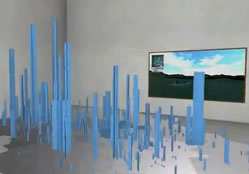
As part of the MRes in Advanced in Spatial Analysis and Visualisation, here in CASA we have been looking at various techniques to visualise urban data. One such technique is the creation of a 3D exhibition space, allowing agent based models and urban data to be visualised within an architectural space.
Music by Portoponte

As part of the MRes in Advanced in Spatial Analysis and Visualisation, here in CASA we have been looking at various techniques to visualise urban data. One such technique is the creation of a 3D exhibition space, allowing agent based models and urban data to be visualised within an architectural space.
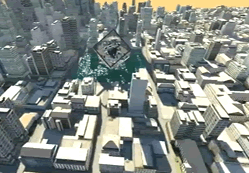
The movie above combines the use of CityEngine in Lumion with SketchUp and 3DMax to insert an exhibition space into a city while burning the CASA logo into the street network. CityEngine is a notable step forward for ESRI, both in terms of visualisation and analysis, linking it with Lumion and SketchUp allows it to be taken even further, towards the ultimate city creation toolkit...
2012-03-20
City in a Book: Augmenting the CityEngine
Over the past few days we have been working on a series of techniques to visualise and augment procedural cities.
.JPG)
If you add in a model of a BenQ projector, the MRes in Advanced Spatial Analysis and Visualisation Handbook, a city within the CASA logo and a webcam you get the following augmented reality:
We are exploring this as part of our digital visualisation module on the MRes here in CASA, aiming to build in the latest research into the lectures. The combination of Lumion, 3DMax, Illustrator, CityEngine and AR is intriguing...
.JPG)
If you add in a model of a BenQ projector, the MRes in Advanced Spatial Analysis and Visualisation Handbook, a city within the CASA logo and a webcam you get the following augmented reality:
We are exploring this as part of our digital visualisation module on the MRes here in CASA, aiming to build in the latest research into the lectures. The combination of Lumion, 3DMax, Illustrator, CityEngine and AR is intriguing...
2012-03-19
ESRI CityEngine - Creating Cities inside Logos and Logos inside Cities
The best way to learn new modelling software is to step away from complex data and take a side look at its capabilities. We have used this approach to run through the various features of CityEngine, producing a series of movies based around the logo of the Centre for Advanced Spatial Analysis, here at University College London.
 First up we integrated the CASA logo into the cityscape by manually tracing the logo and building a network around it. Via an import into iMovie the result is a playful fly around the logo:
Taking the concept further we built the city around the logo, using the nodes and hubs as interconnected cityscapes. With the city base rising out the sea it presents a different feel to the original movie:
Finally, we used an alpha channel on the logo, allowing us to lower the outline onto the cityscape:
The combination of Adobe Illustrator, ESRI CityEngine, AutoDesk 3DMax and finally Lumion make for a rapid way to create unique cityscapes. The next steps are to integrate actual data.....
 First up we integrated the CASA logo into the cityscape by manually tracing the logo and building a network around it. Via an import into iMovie the result is a playful fly around the logo:
Taking the concept further we built the city around the logo, using the nodes and hubs as interconnected cityscapes. With the city base rising out the sea it presents a different feel to the original movie:
2012-03-13
Burning a Logo into a City...
This is very much a work in progress post, but we are interested in integrating text/patterns/logos into 3D models of the city. At the moment we are putting a work flow in place to take our CASA logo and burn it into the street patten of a procedural city.

Using the CityEngine, combined with vector files and Lumion/3DMax some interesting results can be obtained, especially if you also build in some physics/particle engine and agent based model capability.


Using the CityEngine, combined with vector files and Lumion/3DMax some interesting results can be obtained, especially if you also build in some physics/particle engine and agent based model capability.

We will have more on this in the coming days....
Update 14th March 2012 - Below is thefirst second draft movie:
Next stages are to build the city over time, we should have a work flow in place soon...
Update 14th March 2012 - Below is the
Next stages are to build the city over time, we should have a work flow in place soon...
2012-02-11
15 Minutes with CityEngine and Lumion....
A quick weekend post - following on from our first look at CityEngine and Lumion we have expanded the visualisation to add in various standard items from the Lumion library along with a surrounding terrain and waterside setting:
Total development time: 15 minutes with rendering 1.5 hours, its getting quicker to make cities....
2012-02-09
CityEngine: ESRI and Lumion a first look.
Yesterday a license for CityEngine landed on our desk from the nice people at ESRI and to be honest we were a little too excited for our own good, after all its only software. However, CityEngine and its integration with ESRI ArcGIS, while maintaining full export capabilities to load into 3DMax/Lumion/Unity etc, is a game changer.

It moves GIS visualisation a step forward while at the same time bringing procedural city modelling into the mainstream game engine world. Over the coming weeks we will be putting the software through its paces and exporting into Max/Lumion and Unity as part of introducing CityEngines onto our MRes in Advanced Spatial Analysis and Visualisation. The clip below details out first output direct from CityEngine into Lumion, adding in a general landscape, sample trees and transport objects:
Linking in our previous post on ArcGIS Twitter Visualisation in Lumion it seems that the worlds of GIS and architectural visualisation/game engines are finally starting to become accessible.

It moves GIS visualisation a step forward while at the same time bringing procedural city modelling into the mainstream game engine world. Over the coming weeks we will be putting the software through its paces and exporting into Max/Lumion and Unity as part of introducing CityEngines onto our MRes in Advanced Spatial Analysis and Visualisation. The clip below details out first output direct from CityEngine into Lumion, adding in a general landscape, sample trees and transport objects:
Linking in our previous post on ArcGIS Twitter Visualisation in Lumion it seems that the worlds of GIS and architectural visualisation/game engines are finally starting to become accessible.
2010-07-13
Procedural/ESRI and NVIDIA: 3D Cities from 2D ArcGIS Data
Procedural and ESRI have teamed up with NVIDIA to set up a pipeline for the creation, analysis and visualization of photorealistic 3D cities from 2D ArcGIS data. The video shows the creation of the 3D model of the City of Rotterdam in CityEngine:
3D in ArcGIS has always been a bit of a love/hate affair with us so the ability to create a workflow that includes the CityEngine is an intriguing development.
3D Rotterdam in the cloud: http://www.procedural.com/showcases/rotterdam.htmlNVIDIA
RealityServer: http://www.mentalimages.com/products/realityserver.html
ArcGIS 3D Analyst: http://www.esri.com/3d
3D in ArcGIS has always been a bit of a love/hate affair with us so the ability to create a workflow that includes the CityEngine is an intriguing development.
3D Rotterdam in the cloud: http://www.procedural.com/showcases/rotterdam.htmlNVIDIA
RealityServer: http://www.mentalimages.com/products/realityserver.html
ArcGIS 3D Analyst: http://www.esri.com/3d
2010-07-01
CityEngine 2010: An Upgrade and New Licensing Models
CityEngine is without question one of the best city authoring systems out there. In the past we always noted pricing as an issue, but with the release of City Engine 2010 they have a whole new pricing structure in place.
Highlights of the update are interactive editing of dynamic city layouts, node-based rule authoring, and a sketching tool for facades. In addition to that, CityEngine 2010 include advanced block subdivision, modeling of curved streets, new rule operations for instancing and asset search, native Collada support for assets, export instances with the new FBX 2011.2.
The clip below illustrates the power of the latest version:
As part of the new licensing models the CityEngine INDIE is available for $495 and CityEngine STUDENT for $149.
Head over to http://www.procedural.com/ for full details and a free trial. Really, if your interested in cities in any shape or form the trial is a must.
Highlights of the update are interactive editing of dynamic city layouts, node-based rule authoring, and a sketching tool for facades. In addition to that, CityEngine 2010 include advanced block subdivision, modeling of curved streets, new rule operations for instancing and asset search, native Collada support for assets, export instances with the new FBX 2011.2.
The clip below illustrates the power of the latest version:
As part of the new licensing models the CityEngine INDIE is available for $495 and CityEngine STUDENT for $149.
Head over to http://www.procedural.com/ for full details and a free trial. Really, if your interested in cities in any shape or form the trial is a must.
2009-12-16
CityEngine 2009.3
The latest version of the CityEngine (2009.3) includes features such as advanced roof types and global texture mapping to make the creation of large urban 3D models even easier. We are big fans of the CityEngine, especially with its ability to import OpenStreetMap data for street layouts.
The movie below details the new City Wizard to create and generate whole cities from pre-defined templates with only a few mouse clicks:
Another nice touch is the ability to download a use a 30 Day trial, even if you have used a previous version.
What better way to spend your Christmas than building cities? Head over to http://www.procedural.com/cityengine/ for full details.
The movie below details the new City Wizard to create and generate whole cities from pre-defined templates with only a few mouse clicks:
Another nice touch is the ability to download a use a 30 Day trial, even if you have used a previous version.
What better way to spend your Christmas than building cities? Head over to http://www.procedural.com/cityengine/ for full details.
2009-07-21
CityEngine to Unity: Rapid City Modelling for Game Engines
The CityEngine is a unique professional tool for creating, visualisating and exporting cityscapes. As such it is of notable use to the games industry with a quick and easy route into either 3D Max or the Unity Engine.
Unity supports a number of input formats, allowing for direct integration with the CityEngine with the following features:
* Direct model export to Unity via Autodesk FBX including textures - thus, generate'n'play your environment with a few clicks only.
* Arbitrary mesh granularities such as per-material groups or editable scene nodes are possible thanks to CityEngine's various export options such as "merge by material" or "single node objects". Most of these options are supported by Unity.
* Collider meshes (almost) for free: The CityEngine's CGA shape grammar is a perfect tool to generate and control low-res collider meshes in Unity (and they always adapt to model iterations).
The video below demonstrates a CityEngine-Unity-workflow.
It is impressive how easy it is nowadays to create buildings/cities and visualise them direct via a game engine...
See http://www.procedural.com/ for full details.
Unity supports a number of input formats, allowing for direct integration with the CityEngine with the following features:
* Direct model export to Unity via Autodesk FBX including textures - thus, generate'n'play your environment with a few clicks only.
* Arbitrary mesh granularities such as per-material groups or editable scene nodes are possible thanks to CityEngine's various export options such as "merge by material" or "single node objects". Most of these options are supported by Unity.
* Collider meshes (almost) for free: The CityEngine's CGA shape grammar is a perfect tool to generate and control low-res collider meshes in Unity (and they always adapt to model iterations).
The video below demonstrates a CityEngine-Unity-workflow.
It is impressive how easy it is nowadays to create buildings/cities and visualise them direct via a game engine...
See http://www.procedural.com/ for full details.
2009-05-26
CityEngine 2009

Procedural have released a new version of their CityEngine - 'CityEngine 2009'. The updated version provides new innovative tools for urban design and modeling on a citywide scale with he aim of working with complex 3D urban environments easier than ever before.
Key highlights of the CityEngine 2009 include:
#1: Interactive Editing (immediate mode, undo/redo, etc.)
#2: Improved 3D Export (Collada with instancing, 3ds Max, etc.)
#3: Support for Geospatial Data (import/export of GIS data)
#4: Improved Street Geometries (with round curbs, junction handling, etc.)
#5: Occlusion in CGA Shape Grammar (to query the spatial context)
#6: Reporting Functionality (Excel tables for master plans)
#7: Python Interface (to speed up and streamline repetitive tasks)
#8: Floating License (enables flexible network licensing installations)
Of particular note is the ability to import .shp files opening up the possibility to import MasterMap data into The City Engine and the report output for urban planning, the video below provides details on this feature:
There is also a free 30 day trial which is well worth a go..
2009-04-15
New York City 2259

Procedural with their impressive cityengine is certainly a company to watch, we have had a chance to use their demo and the ability to import GIS layers, combined with the rapid creation of cities is certainly impressive. As such their work on New York City 2259 is well worth a look.
NYC 2259 by is the extrapolation of New York city 250 years into the future, inspired by the great 1998 motion picture The Fifth Element.
Today's street network of NY, imported from openstreetmap.org, has been extended to a bigger area, available due to the lower water levels in the future.
The example includes grammar rules to create futuristic skyscrapers in two levels of detail as well as flying cars - press play below:
Take a look at the NYC 2259 page for full details...
2008-12-18
CityEngine - Now for Mac

We have been oddly quiet on the blog about the CityEngine, mainly due to a slight melt down in the lab of our windows machines. As such we are overjoyed by the release of the CityEngine for the Mac by Procedural Inc.
Featured below is a city based on the Apple Logo:
The CityEngine is one of the most powerful tools currently available for the creation of urban environments. Of note is its ability to import OpenStreet map data allowing a 3D road network to be quickly and easily developed.
The movie below illustrates the construction of a fantasy city:
Finally below illustrates the rebuilding of Rome:
We hope to set aside a few days in the new year to take a close look at the CityEngine - you can download a 30 day demo direct from Procedual.
2008-07-15
CityEngine: New Movies
Procedural Inc. is a company specialising in software for the efficient creation of 3D buildings and cities. With it's flagship product, the CityEngine the company is gearing up for release with some new movies:
Preview of the CityEngine:
Future City Generation:
Transformations in Architectural Design
The software is aimed at the efficient creation of virtual 3D worlds and digital sets with targeted markets including interactive and filmed entertainment, architecture, simulation, archaeology and the 3D Internet.
Hopefully we will have a 'hands on' view of the software soon, it looks like being one the most exciting releases for city building for some time.
See http://www.procedural.com/ for full details.
Preview of the CityEngine:
Future City Generation:
Transformations in Architectural Design
The software is aimed at the efficient creation of virtual 3D worlds and digital sets with targeted markets including interactive and filmed entertainment, architecture, simulation, archaeology and the 3D Internet.
Hopefully we will have a 'hands on' view of the software soon, it looks like being one the most exciting releases for city building for some time.
See http://www.procedural.com/ for full details.
Subscribe to:
Posts (Atom)