























Below we provide full details for 2012 entry on the new MRes in Advanced Spatial Analysis and Visualisation (ASAV). The course reflects the current state of play in geographic, urban and architectural information systems with an emphasis on visualisation, analysis and modelling. Taught at the Centre for Advanced Spatial Analysis, home of digital urban, it is an innovative and exciting opputunity to study at UCL with a MRes acting as a pathway to a PhD or further career in ASAV.
Showing posts with label 3dmax. Show all posts
Showing posts with label 3dmax. Show all posts


2012-06-13
City in the Sky: 3D Max, V-Ray, Timelapse and After Effects
'City in the sky' is a concept about an imaginary tranquil oasis above the mega-developed and polluted city, where one can escape from the everyday noise and stress. It was developed as part of the 'Megatropolis' project, which started in London with few companies and artists, invited to create their own visions for the future mega-developed city. The metropolis depicted in the video is New York City because that's where most of the production happened.While the overall 'Megatropolis' project didn't reach a final stage, the presented concept grew into this architectural utopia.
City in the sky from Tsvetan T on Vimeo.
The inspiring movie below is rendered with 3DSMAX and V-Ray. Additional footage and time-lapses shot with Canon5D MKII in New York City. Post&FX in AE:
The end night shot is especially noteworthy...
Take a look at http://www.hrama.com/skycity/ for more info.
Take a look at http://www.hrama.com/skycity/ for more info.
2012-05-09
ESRI CityEngine, Lumion, and SketchUp - The Ultimate City Toolkit?
Over the last few weeks we have been looking at ESRI's CityEngine and how it can be used to create rapid urban scenes. As we noted it moves GIS visualisation a step forward while at the same time bringing procedural city modelling into the mainstream game engine world. Of course the heart of the CityEngine is the ability to import real world data but to get to grips with the interface it is sometimes easier to look at creating urban scenes from simple procedural rules.

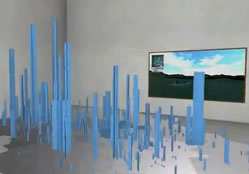
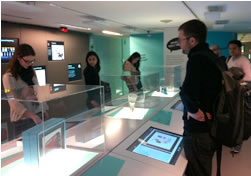
As part of the MRes in Advanced in Spatial Analysis and Visualisation, here in CASA we have been looking at various techniques to visualise urban data. One such technique is the creation of a 3D exhibition space, allowing agent based models and urban data to be visualised within an architectural space.
Music by Portoponte

As part of the MRes in Advanced in Spatial Analysis and Visualisation, here in CASA we have been looking at various techniques to visualise urban data. One such technique is the creation of a 3D exhibition space, allowing agent based models and urban data to be visualised within an architectural space.
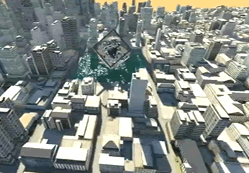
The movie above combines the use of CityEngine in Lumion with SketchUp and 3DMax to insert an exhibition space into a city while burning the CASA logo into the street network. CityEngine is a notable step forward for ESRI, both in terms of visualisation and analysis, linking it with Lumion and SketchUp allows it to be taken even further, towards the ultimate city creation toolkit...
2012-03-20
City in a Book: Augmenting the CityEngine
Over the past few days we have been working on a series of techniques to visualise and augment procedural cities.
.JPG)
If you add in a model of a BenQ projector, the MRes in Advanced Spatial Analysis and Visualisation Handbook, a city within the CASA logo and a webcam you get the following augmented reality:
We are exploring this as part of our digital visualisation module on the MRes here in CASA, aiming to build in the latest research into the lectures. The combination of Lumion, 3DMax, Illustrator, CityEngine and AR is intriguing...
.JPG)
If you add in a model of a BenQ projector, the MRes in Advanced Spatial Analysis and Visualisation Handbook, a city within the CASA logo and a webcam you get the following augmented reality:
We are exploring this as part of our digital visualisation module on the MRes here in CASA, aiming to build in the latest research into the lectures. The combination of Lumion, 3DMax, Illustrator, CityEngine and AR is intriguing...
2012-02-02
Data Space: Agent Based Models, SketchUp, Visualisation, ArcGIS and Lumion
Over the past few weeks we have been exploring exploring new methods and techniques for visualising data. Developed as part our Masters course in Advanced Spatial Analysis and Visualisation we are now looking into issues of scale, realtime rendering, rapid visualisation and 3D exhibition spaces.

Regular readers will know we have been exploring Unity due its interactive nature and ability to import various file types into its game engine (see Particles, Agents and Emergent Behaviour ). Unity is still an option but for rapid visualisation Lumion also offers distinct possibilities. The movie below details our first draft example of building an exhibition space (SketchUp), retexturing and adding various crowd/delegate models (3DMax) and the Twitter map (ArcGIS) using Lumion:
If Lumion offered a stand alone viewer rather than purely movie based output then it would be our engine of choice. As such it is currently a weigh up between Lumion and Unity, our Unity example is under development, we will post it soon as we can...

Regular readers will know we have been exploring Unity due its interactive nature and ability to import various file types into its game engine (see Particles, Agents and Emergent Behaviour ). Unity is still an option but for rapid visualisation Lumion also offers distinct possibilities. The movie below details our first draft example of building an exhibition space (SketchUp), retexturing and adding various crowd/delegate models (3DMax) and the Twitter map (ArcGIS) using Lumion:
If Lumion offered a stand alone viewer rather than purely movie based output then it would be our engine of choice. As such it is currently a weigh up between Lumion and Unity, our Unity example is under development, we will post it soon as we can...
2011-07-19
Megalomania: City in Total Construction
Some city animations simply stand out - Megalomania is one of these stunning examples, perceiving the city in total construction. The built environment is explored as a labyrinth of architecture that is either unfinished, incomplete or broken. Megalomania is a response to the state of infrastructure and capital, evolving the appearance of progress into the sublime.
Constructed predominantly using 3d Studio Max and rendered with Vray. Organic movement sequences were originally filmed on a Canon 5D mkII, tracked in PF Track and developed in CG. Demolition created using Rayfire. All compositing done in Adobe After Effects, edited in Adobe Premiere Pro. Audio recorded and coordinated using Adobe Audition.
More information about the project at thoughtsnotthoughts.blogspot.com/
2010-08-03
Rubika: Animated Urban Short for Canal +
Below is an amazing extract from a short named Rubika produced for "Le Laboratoire" (Canal +). The short was co-directed by Ludovic Habas and Claire Baudeanit with 6 classmates and Guillaume Plantevin, a 2D artist, who gave them the original idea and the universe.
Extract of Rubika ( Le laboratoire - Canal + ) from Ludovic HABAS on Vimeo.
We think the clip is simply stunning and to top it all below is a 'making off' detailing the character animation and a few insights into the building of the world:
Ludovic Habas - MAXscript making Of Rubika from Ludovic HABAS on Vimeo.
Inspiring work.
We think the clip is simply stunning and to top it all below is a 'making off' detailing the character animation and a few insights into the building of the world:
Inspiring work.
2010-07-19
Polygon Graffiti
QNQ/AUJIK from Kyoto, Japan has used 3D Studio Max 2009, Vray 1.5 sp4, Real Flow 4, Syntheyes, After Effects, Premiere, a Canon HV30 and finally a Merlin Steadicam to create the movie below:
Polygon Graffiti from QNQ/AUJIK on Vimeo.
Rendering time came in at 50 hours running on a Intel Quad 3.5Ghz processor. It an impressive array of software and techniques, cumulating in a impressive clip.
Rendering time came in at 50 hours running on a Intel Quad 3.5Ghz processor. It an impressive array of software and techniques, cumulating in a impressive clip.
2010-05-11
Tiltshift, City and Robot - RenkeBot Lives
Tiltshift, 3D Max a city and robot, really whats not to like:
RenkeBot Lives- part2! from Matt Moses on Vimeo.
Created by Matt Moses the city backplates were shot with the Canon 7D and a Tilt Shift lens. Tilt shift lenses give it that "tiny town" look of small scale DOF. Matt built and textured the robot in 3dsmax, and rigged him using CAT - Rendered in Finalrender, composited in Combustion. All three shots took 3 days, including a day to build the robot.
Only only gripe - we wish is was a bit longer, really nicely done.
Created by Matt Moses the city backplates were shot with the Canon 7D and a Tilt Shift lens. Tilt shift lenses give it that "tiny town" look of small scale DOF. Matt built and textured the robot in 3dsmax, and rigged him using CAT - Rendered in Finalrender, composited in Combustion. All three shots took 3 days, including a day to build the robot.
Only only gripe - we wish is was a bit longer, really nicely done.
2010-05-01
5 Movies on Particles, Agents and Emergent Behaviour
Crowd, transport and urban simulations are at their roots down to 'Agents' or 'Objects' that are assigned a set of rules as to how to moves in relation to both the environment and other agents around them. 3D Studio Max has a built in 'Crowd and Delegate' system which can be used to assign behaviour and therefore create realistic traffic of pedestrian systems in 3D space.
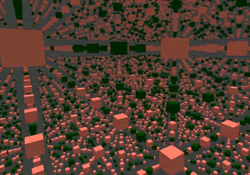
The movie below displays our first tentative steps to explore emergent behaviour via the introduction of simple rules. The movie starts out with a basic 'wander' behaviour where the agents only knowledge is the shape of the surface. Moving on we assign each of our 'cubes' (of which we have become quite fond of...) a level of vision so they can see ahead and therefore avoid each other and objects in their environment.
Previous steps in our visualisation of agent based models are based around a simple flocking examples
This model is an attempt to mimic the flocking of birds, while the resulting motion also resembles schools of fish. The flocks that appear in this model are not created or led in any way by special leader rather, each bird is following exactly the same set of rules, from which flocks emerge.
We have exported the model into 3D Max providing the visualisation below, as ever these are early days but the results seem to run well with 300 'birds' over 1000 frames. The birds are rendered as cubes at the moment for proof of concept:
Flocking in NetLogo exported to 3D Max from digitalurban on Vimeo.
Music "Funkmelon Blooz" (Electronica)
The birds follow three rules: "alignment", "separation", and "cohesion". "Alignment" means that a bird tends to turn so that it is moving in the same direction that nearby birds are moving. "Separation" means that a bird will turn to avoid another bird which gets too close. "Cohesion" means that a bird will move towards other nearby birds (unless another bird is too close). When two birds are too close, the "separation" rule overrides the other two, which are deactivated until the minimum separation is achieved.
The three rules affect only the bird's heading. Each bird always moves forward at the same constant speed.
If we were using the built in Crowd and Delegate system a true 3D flocking system would be possible, but it would be pure visualisation, by importing via NetLogo you gain access to the raw data and thus spatial analysis is possible. It is also quick to model and provides the best of both worlds - 3d visualisation and complex modelling.
While 3D Max is of use for crowd and particle simulation when it comes to modelling complex systems an external package is required, such as NetLogo. The movie below details our first steps at CASA (home of digital urban) to export a basic traffic model from NetLogo into 3D Studio Max. The import script was written by our new PhD student, Ateen Patel and opens up a vast array of opportunities to both visualise and model the city.
Music by The Tedd-Z Cookbook, Aerodrome (Funky Shuffle Remix)
NetLogo is a cross-platform multi-agent programmable modeling environment that is widely. It is particularly well suited for modeling complex systems developing over time. Modelers can give instructions to hundreds or thousands of independent "agents" all operating concurrently. This makes it possible to explore the connection between the micro-level behavior of individuals and the macro-level patterns that emerge from the interaction of many individuals.(Nation Master Encyclopedia).
How does this relate to the city? The next part is to put in real geographical data and to get the agents movies and reacting to each other on a spatial network, more on that to come. Perhaps using a particle system as per the movie below:
The virtual exhibition space has been placed on hold due to work pressures on other projects over the last few months but is something we hope to return to soon.
The movie below displays our first tentative steps to explore emergent behaviour via the introduction of simple rules. The movie starts out with a basic 'wander' behaviour where the agents only knowledge is the shape of the surface. Moving on we assign each of our 'cubes' (of which we have become quite fond of...) a level of vision so they can see ahead and therefore avoid each other and objects in their environment.
Crowd and Delegates - Emergent Behaviour from digitalurban on Vimeo.
Previous steps in our visualisation of agent based models are based around a simple flocking examples
This model is an attempt to mimic the flocking of birds, while the resulting motion also resembles schools of fish. The flocks that appear in this model are not created or led in any way by special leader rather, each bird is following exactly the same set of rules, from which flocks emerge.
We have exported the model into 3D Max providing the visualisation below, as ever these are early days but the results seem to run well with 300 'birds' over 1000 frames. The birds are rendered as cubes at the moment for proof of concept:
Flocking in NetLogo exported to 3D Max from digitalurban on Vimeo.
Music "Funkmelon Blooz" (Electronica)
The birds follow three rules: "alignment", "separation", and "cohesion". "Alignment" means that a bird tends to turn so that it is moving in the same direction that nearby birds are moving. "Separation" means that a bird will turn to avoid another bird which gets too close. "Cohesion" means that a bird will move towards other nearby birds (unless another bird is too close). When two birds are too close, the "separation" rule overrides the other two, which are deactivated until the minimum separation is achieved.
The three rules affect only the bird's heading. Each bird always moves forward at the same constant speed.
If we were using the built in Crowd and Delegate system a true 3D flocking system would be possible, but it would be pure visualisation, by importing via NetLogo you gain access to the raw data and thus spatial analysis is possible. It is also quick to model and provides the best of both worlds - 3d visualisation and complex modelling.
While 3D Max is of use for crowd and particle simulation when it comes to modelling complex systems an external package is required, such as NetLogo. The movie below details our first steps at CASA (home of digital urban) to export a basic traffic model from NetLogo into 3D Studio Max. The import script was written by our new PhD student, Ateen Patel and opens up a vast array of opportunities to both visualise and model the city.
Music by The Tedd-Z Cookbook, Aerodrome (Funky Shuffle Remix)
NetLogo is a cross-platform multi-agent programmable modeling environment that is widely. It is particularly well suited for modeling complex systems developing over time. Modelers can give instructions to hundreds or thousands of independent "agents" all operating concurrently. This makes it possible to explore the connection between the micro-level behavior of individuals and the macro-level patterns that emerge from the interaction of many individuals.(Nation Master Encyclopedia).
How does this relate to the city? The next part is to put in real geographical data and to get the agents movies and reacting to each other on a spatial network, more on that to come. Perhaps using a particle system as per the movie below:
Particles in the City from digitalurban on Vimeo.
The virtual exhibition space has been placed on hold due to work pressures on other projects over the last few months but is something we hope to return to soon.
2010-02-03
Create a Cityscape with 3D Max 2010
Hammer Chen got in contact this morning regards a video tutorial detailing how to create a cityscape with 3D Max 2010. Is a good movie, we like the link to Google Maps:
Hammer works as a technical director / trainer in Gemhorn Inc, an Autodesk local reseller in Taiwan, you can see the full tutorial via his blog post.
Hammer works as a technical director / trainer in Gemhorn Inc, an Autodesk local reseller in Taiwan, you can see the full tutorial via his blog post.
2009-10-09
GPS Import into 3DMax
UrbanTick - a blog written just a few desks away from where we sit - is looking into the way a city lives and breathes. Part of the work is based on the visualisation of GPS tracks, so linking in with another project here at CASA, Richard Milton has written a script to import GPS tracks directly into 3D Studio Max. The script imports a gpx. file and creates a spline for the path, a marker object and time frames for each point.
UrbanTicks first example movie can be seen below:
We need to check the guidelines on the grant that was used to make the script but we think we should be able to release it, hopefully next week...
See http://urbantick.blogspot.com/ for full details on the research and more movies/maps.
UrbanTicks first example movie can be seen below:
3dsMaxGPStest from urbanTick on Vimeo.
We need to check the guidelines on the grant that was used to make the script but we think we should be able to release it, hopefully next week...
See http://urbantick.blogspot.com/ for full details on the research and more movies/maps.
2009-05-12
Portland 3D City Model
The movie above details a digital 3D model of Portland, Oregon created by NC3D using information gathered from Metro, the City of Portland, ODOT, Tri-Met and numerous firms and individuals including Williams and Dame Development, Ankrom Mosian, FFA, GBD, Hennebery Eddy, Thomas Hacker and ZGF Architects.
The Portland City Model was created in 3D Studio Max and is available for license direct from NC3D...
2009-02-17
Greeble Earth
Below is a quick image we are working on for a book cover - its draft and the main version will not have the star like background. We would not normally put up draft images but hey:
 It was made using our Greeble Tutorial modified to simply use the technique on a sphere.
 It was made using our Greeble Tutorial modified to simply use the technique on a sphere.
2009-02-10
Animated Architectural Timelapse
Animated Architectural Timelapse from MILapse on Vimeo.
We really like this one - the movie combines HDR, timelapse sequences and 3DMax/VRay in one unique architectural animation. The use of timelapse imagery lends itself perfectly to architectural visualisation and the author MILapse of http://www.hdrtimelapse.com/ is one of the techniques leading lights.
Take a look at MIlapse on Vimeo for more examples.
2008-11-19
Flocking: NetLogo to 3DMax
 The next step in our visualisation of agent based models is a simple flocking example.
 This model is an attempt to mimic the flocking of birds, while the resulting motion also resembles schools of fish. The flocks that appear in this model are not created or led in any way by special leader rather, each bird is following exactly the same set of rules, from which flocks emerge.
We have exported the model into 3D Max providing the visualisation below, as ever these are early days but the results seem to run well with 300 'birds' over 1000 frames. The birds are rendered as cubes at the moment for proof of concept:
Flocking in NetLogo exported to 3D Max from digitalurban on Vimeo.
Music "Funkmelon Blooz" (Electronica)
The birds follow three rules: "alignment", "separation", and "cohesion". "Alignment" means that a bird tends to turn so that it is moving in the same direction that nearby birds are moving. "Separation" means that a bird will turn to avoid another bird which gets too close. "Cohesion" means that a bird will move towards other nearby birds (unless another bird is too close). When two birds are too close, the "separation" rule overrides the other two, which are deactivated until the minimum separation is achieved.
The three rules affect only the bird's heading. Each bird always moves forward at the same constant speed.
If we were using the built in Crowd and Delegate system a true 3D flocking system would be possible, but it would be pure visualisation, by importing via NetLogo you gain access to the raw data and thus spatial analysis is possible. It is also quick to model and provides the best of both worlds - 3d visualisation and complex modelling.
How does this relate to the city? The next part is to put in real geographical data and to get the agents movies and reacting to each other on a spatial network, more on that to come.
You can download NetLogo from here, its comes with a excellent tutorial so you can start building your own model.
2008-11-14
NetLogo to 3DMax: Complex Models and 3D Visualisation
We have been running a series of posts recently looking at crowd simulation, dynamics and particles in 3D Max. The aim is to visualise the complex systems that make up the city within an environment that allows both clear and easy visualisation and export capabilities to other packages such as Crysis or Google Earth.
While 3D Max is of use for crowd and particle simulation when it comes to modelling complex systems an external package is required, such as NetLogo. The movie below details our first steps at CASA (home of digital urban) to export a basic traffic model from NetLogo into 3D Studio Max. The import script was written by our new PhD student, Ateen Patel and opens up a vast array of opportunities to both visualise and model the city.
NetLogo to 3D Max - Proof of Concept from digitalurban on Vimeo.
Music by The Tedd-Z Cookbook, Aerodrome (Funky Shuffle Remix)
NetLogo is a cross-platform multi-agent programmable modeling environment that is widely. It is particularly well suited for modeling complex systems developing over time. Modelers can give instructions to hundreds or thousands of independent "agents" all operating concurrently. This makes it possible to explore the connection between the micro-level behavior of individuals and the macro-level patterns that emerge from the interaction of many individuals.(Nation Master Encyclopedia)
We will have more posts on complex systems and visualising the city over the coming weeks and months.
See http://gisagents.blogspot.com/ for more on modelling, agents and the city.
While 3D Max is of use for crowd and particle simulation when it comes to modelling complex systems an external package is required, such as NetLogo. The movie below details our first steps at CASA (home of digital urban) to export a basic traffic model from NetLogo into 3D Studio Max. The import script was written by our new PhD student, Ateen Patel and opens up a vast array of opportunities to both visualise and model the city.
NetLogo to 3D Max - Proof of Concept from digitalurban on Vimeo.
Music by The Tedd-Z Cookbook, Aerodrome (Funky Shuffle Remix)
NetLogo is a cross-platform multi-agent programmable modeling environment that is widely. It is particularly well suited for modeling complex systems developing over time. Modelers can give instructions to hundreds or thousands of independent "agents" all operating concurrently. This makes it possible to explore the connection between the micro-level behavior of individuals and the macro-level patterns that emerge from the interaction of many individuals.(Nation Master Encyclopedia)
We will have more posts on complex systems and visualising the city over the coming weeks and months.
See http://gisagents.blogspot.com/ for more on modelling, agents and the city.
2008-11-11
3D Max: Balls in the City

Following on from yesterday's post on particle visualization we turn our eye towards 'reactor' in 3D Max to give objects mass and thus make use of the built in Havok physics engine.
The ability to add mass, friction, elasticity, etc allows various behaviors to be simulated and therefore a possible route to simulate the city. These are early days and we wouldn't normally make such movies public, but in many ways that's what the blog is all about.
So below is our first test at using reactor - there are obvious errors but we went for a 'non realistic' bounce with lots of energy and we think it shows potential:
3D Max Balls in the City from digitalurban on Vimeo.
Music by Portoponte
It was surprisingly easy to create, we are thinking of putting together a short tutorial, if people would be interested, as we couldn't find a suitable one ourselves.
Where are we going with all this? Towards a simulated city for 'what if' scenarios, either using packages such as 3D Max/Maya/Houdini etc or more traditional Java based modelling approaches through to a return to gaming and the Crysis Engine.
More blog posts with various tips/tutorials etc to follow as we progress....
2008-11-07
Particles in the City: Agents For Understanding Flow and City Dynamics
 We thought we would put up a quick post on 'what we are currently doing'... At the moment we are looking into simulating and visualising flow in the city, linked into our earlier 3D based agent work. Its early days but using a particle system linked to known wind dynamics and a 3D city model you can create a rapid visualisation of the dispersion of particles. This maybe useful if, for example, a 'dirty bomb' was exploded or if some sort of contamination was detected.
Taking this further it can also be used for crowd modelling and pedestrian evacuation analysis within the cityscape. We are using our 'fantasy city' as a first test bed, rather than our London model at the moment as its easier to work with in the first stage of development...
You can see how we created the model via our Fantasy City Tutorial for 3D Studio Max.
2008-11-06
Back to Oblivion: Final Import Movie Elder Scrolls IV - SketchUp Model
 Scanning our old hard drive we came across our final movie detailing the results of a tutorial for importing Google SketchUp models into the Oblivion gaming engine. We thought it was lost to a previous hard drive crash but having found it we thought it was worthy of uploading to Vimeo and sharing again:
Oblivion Mod: University College London Quad from digitalurban on Vimeo.
The process of going from Google SketchUp to Oblivion is well worth it, simply follow our two part tutorial on importing objects SketchUp/3DMax into Oblivion.
Subscribe to:
Posts (Atom)