CityDashBoard TalesofThings MapTube
Qrator Tutorials About Digital Urban
MRes ASAV SurveyMapper Contact Us
Showing posts with label virtual worlds. Show all posts

2012-05-31

SLACTIONS 2012 Machinima - International Festival

This year, and for the first time, the SLACTIONS Steering Committee has included a day devoted to Machinima in the conference program. The SLACTIONS 2012 Machinima Festival is a Machinima competition included on the SLACTIONS 2012 Research conference on virtual worlds. 


Conference calls are to be honest normally slightly dull, this one however is inspriational and its just got us fired up again about virtual worlds:


The RL/SL conference takes place between 15 November 2012 and 17 November 2012. 


Official SLACTIONS 2012 website http://www.slactions.org/2012/?page_id=152


Thanks to Dr Andrew Crooks of  www.gisagents.blogspot.com  for sending this our way.

2009-09-28

Archi-Me - Launches to Transform 3D CAD Models (?)

To be honest we are always a little skeptical of press releases and tend not to post direct quotes as they often simply over-hype a product. As such it is with interest that we find the following:

****

MOOFU, a fast-growing UK company focusing on emerging technology, emerging markets and emerging people, today announces the launch of Archi-Me, a new solution that enables designers to create fully interactive avatar-based virtual environments from 3D CAD models.

Archi-Me changes the way designers and clients imagine, visualise and test projects by creating high-quality environments that people can explore in much the same way as in a computer game, with an avatar and user-friendly interface.

****

The clip below details the system:


The clip is not all that impressive and the with systems based around Unity or OpenSim via the ArchNetwork it looks like Archi-Me has a lot to live up to - but as the press release carries on -

***
MOOFU has launched Archi-Me after receiving an exceptional response to calls for early adopters from companies in the UK, USA, India, Italy and New Zealand. The technical team has created stunning virtual environments for schools, recreation buildings and a luxury villa.

****

Perhaps we have got the wrong end of the stick on this one but we cant see designers using the system with the current state of the avatars/lighting compared to others on the market (?)

See www.archi-me.com for full details.

Feel free to agree or disagree via the comments....

2009-07-30

Sketchlife: SketchUp to Second Life

We have never quite understood why Second Life is such a closed shop when it comes down to importing models - compared to systems such as Sketch Worlds, which we covered earlier this week, it has been a positively painful process to get any model in the environment. However, Sketchlife is a step in a right direction, allowing models to be built in SketchUp and import to Second Life.

The video below details a simple model of the words "Hello World" being built and uploaded using Sketchlife tools. It demonstrates the process: press "Export", copy and paste the model key, drop the textures into the box, and, finally, copy and paste the build key. The process is the same for all models:


Written by Evgeni Sergeev the plugin for SketchUp is available for free, take a look at http://vrshed.com/sketchlife/ for details and download.

2009-07-28

Sketch Worlds: 3D Max and SketchUp Virtual World for Architectural Visualization

SketchWorlds, based on RealXtend, is unique - a virtual world with architectural and property based visualisation at the heart of the system.

Of note is the ability to import direct from 3DMax and SketchUp allowing for quick and easy modelling within a virtual environment, something that is almost impossible with any degree of detail in other systems such as Second Life.

The movie below details the in-world editor, note the dynamic lighting:


As regular readers will know we have a bit of thing with HDR, SketchWorlds allows real time HDR rendering:


Take a look at http://sketchworlds.com/ for full details, from a first look it seems promising.

2009-07-21

Simurban and Mycosm: New Virtual World and Urban Viz Systems


We have just come across 'SIMMERSION' a company with two interesting products in development. The first is Simurban, 3D visualisation3D simulation software aimed at creating, viewing and allowing the user to interact with accurate and realistic models of any built environment.

The movie below details Simurban running in realtime:


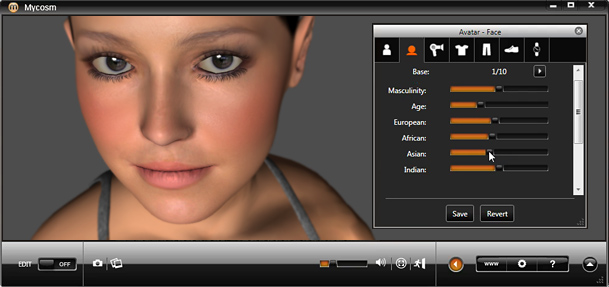
Of particular note however is Mycosm a new virtual world sytem under development - requests are currently open for private beta testers. The Mycosm 3D engine is aimed to give 3D artists and gamers the power and performance they need while delivering rich photo realistic imagery in a simple and familiar interface.

Mycosm allows you to create your own unique online virtual world by using intuitive tools and importing high-quality 3D content. You can then share it with the community online, play games, share media, talk with friends and make money.

From the screen shots Mycosm is one to watch - take a look at http://www.mycosm.com/ to sign up for the private beta.

2009-03-26

Thoughts, Reports and Rambles from the AAG: Virtual Learning Environments and Geographic Education

Day 4 at the AAG and sitting in a session on Virtual Learning Environments and Geographic Education – its one of the best line ups of the conference so far.

First up is Michael N .DeMers of New Mexico State University with a talk entitled: Using Second Life to Augment an Online GIS Course..

The use of the virtual world called Second Life as a platform to enhance a traditional WebCT-based online GIS class is examined. Second Life provides an ability to enhance the social presence often lacking from typical discussion-based online classes. The ability of students to get together builds community and promotes collaboration.

More than just providing opportunities for traditional delivery methods like slides and discussions, Second Life provides a powerful set of 3-D building tools that allow tactile learners an ability to express their knowledge in ways that are difficult to reproduce outside of such an environment.

While some students find virtual worlds very difficult to negotiate others, particularly gamers adapt very quickly. For non-gamers the use of Second Life is best used to provide ways for students to get together for in-world discussions and study. Second Life then, when used properly, and with the student learning style kept in mind, provides something for every type of learner.

Michael makes the point that Second Life is not a game, it is a free form virtual world which takes time to create and build things. It also takes time to learn which creates the barriers that many put up upon first entry. He creates a ‘lab in a box’ using wrapped up course materials, directions, maps etc included in a box that can be rezzed. Finally Michael notes that the impact on the learning cycle is notable as it provides the students with the ability to visualize, for example ‘map projections’ in three dimensions – something that is not possible via text book. It also encourages active experimentation

A really well presented and interesting talk

Second up is Merril Johnson of the University of New Orleans talking about:

Virtual worlds such as Second Life are emerging as intriguing windows into the future of technology. According to the Gartner Group, 3-D Web will become mainstream in the next two-to-five years as Internet users construct 3-dimensional personas in new virtual geographies. Many of these geographies are being populated by residents with identities not at all like those in the real world, who come together in communities dedicated to the exploration and development of constructed identities. In other cases, residents create identities and communities that reflect and augment the real world. In either instance, opportunities become available for students interested in the study of places and their inhabitants. The purpose of this presentation is to examine identity creation in virtual worlds, focusing on Second Life; how this phenomenon affects the "cultural" geography of virtual worlds; and how this new geography can be put to the service of geographical education.
Third is L.Jesse Rouse and Susan J.Bergeron of West Virginia University with a talk on ‘Building and Experiencing Virtual Worlds.

Third up is L Jesse Rouse and Susan Bergeron – of West Virginia University, - also known as those nice people from Very Spatial, Jesse is presenting.

Technologies that drive videogames have been adopted to build educational tools from early 8-bit game platforms to today's high-end 3D graphics laden game environments. While videogames have been both lauded as the next step in education and condemned as frivolous, it is hard to argue against the prevalence of videogames in the lives of students outside of the classroom (or hidden out of sight of the teacher). In addition, there is a perceived disconnect between traditional teaching methods and those students, referred to as digital natives, who have grown up with access to digital technologies. It is important to look beyond VLE use, to all of the impacts that videogames can have in the classroom.

Staff and students in the Laboratory for Geographic Information Science and the Department of Geology and Geography at West Virginia University are involved in an ongoing project constructing a virtual world based on historic Morgantown, WV. The project began as a way to demonstrate the integration of GIS and Serious Games. The project became a way to not only create a reconstruction of an early 1900s town, but also to involve upper level students in GIS and Urban Geography in the construction of 2D and 3D data and learning about the historic development of the town. In addition, Computer Science student participants are able to apply their programming skills within a domain area. The creation of the virtual world supports not only outreach and introductory classes, but also provides technical experience for upper level students.

We are moving from the traditional classroom into the new digital classroom based on new media, serious games and virtual worlds etc. He uses a good term ‘Edutainment’ - a way to keep students interested and focused above and beyond the usual ‘powerpoint’ presentation.

Realworld data can be presented via ArcScene linked to SketchUp, the work has created over 400 buildings in which point ArcScene ‘falls over’. As such they have moved from ArcScene to create a ‘Spatial Experience Engine’ based on the XNA framework with a move away from polygons to represent architectural details towards textures to speed up the framerate. Information is embedded via the Census within the 3D space allowing the students to connect, learn and experience geographical information within the virtual space.

Again a really interesting and very well presented talk, the use of Second Life, games etc is starting to make notable inroads into geography and teaching. The game engine will be made available online soon as its complete.

Finally up Nicholas Hedley of Simon Fraser University, Spatial Interface Research Lab/Department of Geography.

Nick has another nice term – a ‘Geospatial Metaverse’, noting that T
there has been a quantum leap in the capabilities of MMORPG’s creating new spaces for social interaction and simulation. These virtual worlds are beginning to cross into the real world with financial trading etc.

Nicks abstract is as follows:

Over the past decade, major advances in distributed virtual environment architectures have resulted in a new generation of interactive, low-latency shared virtual spaces accessible by users with modest and high-specification systems alike. Increasingly, reality and virtuality are woven into our everyday lives. In only five years, Second Life has become one of the most widely-used 3D virtual spaces for mainstream collaborative social computing, and is used by over 15 million people. There has also been a quantum leap in the capabilities of MMOGs and MMORPGs, allowing real-time collaborative interaction with complex and dynamic 3D virtual spaces with real-time physics - resulting in physically persistent virtual spaces.

Second Life and contemporary MMORPGs have created new spaces for social interaction, revealing exciting new possibilities for geographic exploration, learning, and collaboration. These environments may be virtual, but are a very real part of the lives of their user networks. They allow ever more seamless movement between real and virtual spaces. The boundary between the real and virtual in everyday spaces is quickly fading. Mixed reality interfaces take this to another level entirely, making it possible to create a virtually-enhanced 3D physical reality. This paper explores how the technologies of Second Life, serious games and mixed reality redefine the relationship between real and virtual spaces, and are evidence that a geospatial metaverse has emerged. Research examples by the author using each of these technologies will be used to demonstrate their potential in geographic education.

On show are some neat outputs using the CryEngine 2 –Virtual Ucluelet noting the ability to simply ‘paint’ geography within the game engine. Virtual environments are becoming part of peoples real lives and is this disconnecting us with the real geographic landscape. The level of work on show is notable, again really refreshing to see Crysis used for geography...

The talk ends with research examples of on-site Augmented Reality – Geospatial ‘XRay vision’, really excellent work.

A series of excellent talks, perhaps representing the cutting edge in geospatial visualization within the geography community. Our 3D Agent Based modeling work – ie 3D Max, Second Life, NetLogo etc work is this afternoon, presented by Andrew Crooks of gisagents.blogspot.com. The main session on Mapping for the Masses is tomorrow at 8am in the main conference centre.

We have also had the pleasure to record a podcast with Very Spatial, it should be online some point soon, it was great to meet and chat with the people behind it…


2009-02-18

Virtual Philadelphia

In the movie below CBS3 reports on Virtual Philadelphia, the first 3D virtual city to offer high resolution at street level. A specialised vehicle was used to capture fine details, such as store fronts and street signs. Users can freely walk down (or fly through) an exact replica of every street in Center City Philadelphia.


Virtual Philadelphia on CBS3 from Steve Jarvey on Vimeo.


Created by GeoSim the geodetic foundation for the city models is based on 3D-polylines derived from 1:6000 scale aerial photography stereo-pairs.

The high-precision photogrammetry measurements (10-15cm) are used to generate accurate, GIS-standard compliant 3D-models that can be used in a variety of engineering and scientific applications. The model is based on gigabytes of aerial photos, street images, laser scans and geodetic measurements of Philadelphia to build an accurate city model. The end result is a model capable of providing a simulation of the physical streets, buildings and urban landscape with the "look and feel" of a real city.

You can take Virtual Philly for a spin at http://www.geosimphilly.com/

2007-12-07

Virtual Cities: Digital Mirrors into a Recursive World, Working Paper No. 125

We present our latest working paper entitled 'Virtual Cities: Digital Mirrors into a Recursive World'. The paper comes in at approximately 9000 words and explores visualisation in cities ranging from Twitter to Second Life and through to NeoGeography and The Paraverse. The abstract below provides a guide to its content and as the title suggests working papers are a work in progress so any feedback is welcome, the final version comes out in a book next year.

Digital cities are moving well beyond their original conceptions as entities representing the way computers and communications are hard wired into the fabric of the city itself or as being embodied in software so the real city might be manipulated in silico for professional purposes.

As cities have become more ‘computable’, capable of manipulation through their digital content, large areas of social life are migrating to the web, becoming online so-to speak.

Here we focus on the virtual city in software, presenting our speculations about how such cities are moving beyond the desktop to the point where they are rapidly becoming the desktop itself. But a desktop with a difference, a desktop that is part of the web, characterized by a new generation of interactivity between users located at any time in any place.

We first outline the state of the art in virtual city building drawing on the concept of mirror worlds and then comment on the emergence of Web 2.0 and the interactivity that it presumes. We characterize these developments in terms of virtual cities through the virtual world of Second Life, showing how such worlds are moving to the point where serious scientific content and dialogue is characterizing their use often through the metaphor of the city itself.

Download the full paper as a .pdf (1.8Mb).

2007-11-05

Implications of the Virtual Gold Rush on The Digital Frontier

In this post we explore the growth and decline of digital cities, examine the passing gold rush that is Second Life and look into the frontier mentality that has resulted in hundreds of digital ghost towns.

The city morphs and changes in real-time, almost as if it were a living and breathing organism its fractal growth ebbs and flows according to a myriad of factors. We are not even close to understanding the growth of the city due to the complexities involved, indeed the city is a man-made system that is currently beyond the understanding of man itself.

This may seem surprising, how can we not understand a system that is planned and laid out by professionals? Teams of people in each geographical sector of every city in the world are currently sat around papers plans, CAD software and a few are partaking in citizen participation using Google Earth. All of these people play a small part in the social shaping of the city alongside others factors such as geographical location, financial stability, population pool and transport suitability amongst thousands of others.

The Virtual City's are perhaps less complex yet still subject to factors that make their growth unpredictable. Social Shaping has a larger role to play with issues such as transport being replaced by available bandwidth and usability or the current ‘in technology’ becoming a defining factor. Within Virtual Worlds Second Life is currently leading the field with previous trail blazers such as ActiveWorlds now falling behind. The Virtual City is all about population, population brings with it the all important social network which in turn leads to city growth, a land market and above all a viable economic system.

A Virtual City’s life is much shorter than its real life counterpart with fictional cities existing on a even shorter temporal existence. A number of factors come into play with the rise and fall of digital cities, new technologies and movement of population being the main. Virtual Cities do not decline and decay like real cities, they remain as pristine as the day they were built, indeed they often improve in appearance as new lighting and texturing techniques are introduced.

Virtual Cities are however extremely susceptible to movements in population. In our previous review of technologies from 1998 we citied ActiveWorlds’ as being a key player in the industry. We ran an ‘ActiveWorld Server’ for a year, logging and tracking the growth of our section of the MetaVerse over time. Out plot of virtual land, approximately the size of Soho in London, went from being a hive of activity with publicity from the main stream media and users effectively ‘living’ in our world 12 hours a day to a digital ghost town over a period of 12 months. A city was born, roads laid out by groups of users collaborating regardless of real-world geographical location and plots of land developed.

A map of the world captured part way through the project is pictured below:


The city consisted of 88,000 objects with a thriving population yet logging back in after the initial frontier town mentality had passed was like walking the streets of a deserted city. The decline is due to a frontier mentality which is both the cause of such rapid growth and the increasing numbers of digital ghost towns littering the Internet.

In the digital world the frontier mentality is all consuming, people are keen to populate and make their mark on new worlds. There is nothing better than virgin digital land where an economy can be etched out, riches made and a home setup. Moving to new virgin land often comes at the cost of the previous system where the gold rush has passed and the remaining population are left wondering where their neighbours went.

Second Life it could be argued is ending its gold rush stage, millions of dollars have been made, cities have been built and hundreds of thousands of people have set up home. The system is therefore at risk from the next big thing on the horizon, the cities currently thriving could soon be digital deserts. As the digital dawn rises with the new lighting system in the Second Life universe the shadows may soon be cast upon empty homes as history repeats itself and users migrate to a new frontier, possibly the widely hyped Metaplace?

Written while waiting to be called into court, currently away from the office and the blog on Jury Service….

2007-09-27

Virtual Worlds Circa 1998: How Much Has Changed?


Second Life, collaborative working, voice chat and others of the Web 2.0 world are so of the moment but the concepts were also all the rage in 1998. This post takes a look back to the day when if we had money we would have invested in virtual worlds - the next big thing.

Hindsight is however a good thing as most of the worlds that showed potential in 1998 were lost when the web bubble burst, but if you think Second Life is new we think its just picking up the ideas from a decade ago.

Voice Chat

Second Life has just enabled voice chat within its virtual world browser, a system called Onlive integrated real-time voice-based communication in VRML (Virtual Reality Modelling Language) environments. A screenshot of our use of Onlive is pictured below, note the Netscape icon in the toolbar to date the image:

To communicate the user was required to press the ctrl key on the keyboard and talk into a connected microphone. The user's voice was then encoded and transmitted into the virtual environment using automatic voice synthesis and three-dimensional audio. The result was real-time conversation with lip synchronised avatars.

With the emphasis on lip synchronisation the avatars were represented as single floating heads which limited to some extent the level of perceived interaction with the environment. To be honest the three dimensional scenes were merely backdrops and the quality of the audio was often poor resulting in dropouts and confused conversations. Indeed, the most widely used phrase in Online was 'pardon', although at least in was in three-dimensional audio.

White Boards and Integrated Powerpoint

Integrating whiteboards and powerpoint presentations is a central part of Second Life, especially for its use by business and academic communities. Setting up a powerpoint presentation takes time and requires scripting, Holodesk however had it built in.

Holodesk was a VRML 2.0 based shared virtual environment from a Pittsburgh-based company called Telepresence. Voice chat was also built into the system but limited to two users at any one time compared to the multiple voice communication of Onlive. Notable additional features were the ability to communicate via shared whiteboards and views prepared graphic slide-based presentations within the virtual environment.

Pictured below is a section of our London work in Holodesk (we were experimenting with scale):

A key limitation of using VRML for multi-user worlds was the inability for any changes to the world to be saved. In essence a VRML world was a scene which although offering some level of interaction did not involve any level of collaboration.

Collaboration and Tool Box Building

If we had bet on any technology system becoming main stream it was the ActiveWorld's browser, back in 1998 it did most of the things now possible in Second Life.

ActiveWorld's was not by any means the first Virtual Worlds system but it, in our view, stands the test of time as one of the best. One needs to bare in mind that back in 1998 Internet technology was still developing and the ability to collaboratively build and share data in a three dimensional world where one is represented as an avatar was like viewing the future.

In addition to being able to build from a large subset of objects the ActiveWorlds server could import objects in .rwx or Renderware format. This opened up the world of architecture with a direct input path from AutoCad and 3DStudio Max.

If you take a look at The ARCH of note is the fact that one of the things architects and users in general are waiting for is the ability to import objects into Second Life from third party programs.

To discuss all things virtual the Avatars 98 Conference was held in ActiveWorlds, run by the Contact Consortium it provides a snapshot of the time:

We guess most of the users are now to be found somewhere in Second Life, of note though is how quick users can be to change to the next big system.

Internet hype arrives in waves of innovation, the current wave is Second Life, as for the next wave? Wasn't there a rumour of a Google Virtual Environment last week?

To Teleport or Not to Teleport: Travelling in Virtual Worlds

Methods of travel within virtual worlds differ according to distance and the rules imposed by the system. The most common method to move large distances is the teleport - allowing new locations to be reached according to a Cartesian co-ordinate system. Teleports are common place within environments such as Second Life and ActiveWorlds with teleportation achieved through either selecting a location on a map or clicking on an object which has been setup with a teleportation script.

As an example, in the panoramic sphere below the small red triangle is a teleport object taking the user back to the main section of our work on Second Nature Island within Second Life.

The same is true of ActiveWorlds with teleports being a key feature of the ability to jump between servers and chosen locations. However, the ability to teleport was not always part of the original ActiveWorlds systems which evolved through the influence of Neal Stephenson's seminal science fiction novel Snow Crash.

In Snow Crash, the ability to teleport was blocked:

You can't just materialise anywhere in the Metaverse... this would be confusing and irritating to the people around you. It would break the metaphor (Neal Stephenson, Snow Crash, 1996, page 42).

Pressure from users resulted in teleportation stations being introduced at select points around the central section of ActiveWorlds original environment known as AlphaWorld, but it caused concern amoung the developers. The New World Times, a virtual newspaper, reported in 1998 that 'there is still some concern that teleportation will ruin the simulation of reality in AlphaWorld'.

Teleportation was subsequently introduced throughout the ActiveWorlds system and it is now central to the majority of virtual environments. Indeed within Second Life teleportation is integral to moving around the world. Pictured below is a map of teleports in our own ActiveWorld circa 1999 (click for a larger version):

In 1998 the developers of ActiveWorlds were worried that teleporting would ruin the simulation, by 2007 the expanse of virtual environments has meant that teleportation is the only option.

In Second Life you can materialise anywhere in the Metaverse, it is not confusing or irritating to the people around you and indeed perhaps even enhances the metaphor...

2007-06-05

Architecture in Virtual Worlds - Second Life/ActiveWorlds and Adobe Atmosphere

Crescendo Design has been using Second Life as a professional tool in their real life practice. Their site states that virtual reality component of their services consists of model homes and current design projects, as well as the Virtual Studio, where they conduct meetings and showcase our work.

The video below provides an insight in the building and construction process within Second Life:


The movie was sponsored by 'The Arch' blog.

The move of architects towards embracing Second Life is of interest as its one that did not happen within ActiveWorlds. Although almost 6 years ago, virtual worlds were looked upon as more of a 'game' rather than a social phenomenon. Yet with the rise of social networks, Second Life is suddenly being embraced by the big players and increasingly the smaller ones as well.

Only yesterday we got a call from a real-estate agent wanting models in Second Life and we cant help thinking that ActiveWorlds was before its time - especially in allowing the ability to import direct from 3DMax/AutoCad so there was no need to rebuild everything.

The movie below illustrates our early photomodelling work in ActiveWorlds - go easy its 5 years old..


Although controversial Second Life just doesn't quite hold up to the hype. It needs the ability to import full polygon models and a realtime (or baked) lighting system ala the long lost Adobe Atmosphere or the recently launched Blink 3D.

For comparison's sake below is a movie of our old work in Adobe Atmosphere:


Whoever withdrew Atmosphere at Adobe may of jumped ship too soon, it was an innovative product and certainly a lot more flexible in terms of virtual architecture than today's Second Life..

* As an update also see the article in Business Week ' Beyond Second Life'

2006-07-26

'There' - The 'There' Metaverse

Following our First Steps in Second Life post we have created a similar movie documenting our entry into the Virtual World system known as 'There'


In the same way as Second Life, 'There' now has free registration so you can log into the environment without having to type in your credit card details. 'There' is described as 'an online getaway where you can hang out with your friends and meet new ones--all in a lush 3D environment that's yours to explore!' As the movie illustrates 'There' has a more cartoony look than Second Life and is all the better for it. There is also the option of 'Premium Membership' for $9.95 which includes Voice Chat and various other upgrades, although the free account is quite adequate for first steps and getting to know the world.

As ever with these worlds we are interested in importing our own objects, we are looking into this and if we manage it will of course post details along with another movie. 'There' is free and if you look beyond the 'fun' element and into the possibilities for collaborative visualisation and architecture then it offers a number of interesting options.

2006-06-23

Second Lifes Digital Metaverse

We have looked into Virtual Worlds in the past, concentrating on ActiveWorlds. Sadly ActiveWorlds doesn't seem to of evolved as many expected it would and other systems have come along using better graphical techniques and more important with a in built economy.


The above clip shows our first steps in Second Life, Business Week has a excellent article which is well worth a read. For the time being we are looking to see if its worth revisiting our 30 Days in ActiveWorlds project and the following papers but in Second Life:

1) 30 Days in ActiveWorlds - Community, Design and Terrorism in a Virtual World. The paper featuees as chapter 8 in the book 'The Social Life of Avatars', Ralph Schroeder (Editor), Springer-Verlag UK.

2) ActiveWorlds: Geography and Social Interaction in Virtual Reality, written with Ralph Schroeder and Avon Huxor, published in Futures, 33 (2001) 569-587.

If you have any thoughts come find me in Second Life - User name Smithee Bertrand....