CityDashBoard TalesofThings MapTube
Qrator Tutorials About Digital Urban
MRes ASAV SurveyMapper Contact Us
Showing posts with label android. Show all posts

2011-05-19

Introducing QRator - iPad and Web Based Living Labels for Museums

QRator is a collaborative project between the UCL Centre for Digital Humanities (UCLDH), UCL Centre for Advanced Spatial Analysis (CASA), and UCL Museums and Collections, to develop new kinds of content, co-curated by the public, museum curators, and academic researchers, to enhance museum interpretation, community engagement and establish new connections to museum exhibit content.
The interactive system is designed to be non intrusive while enabling members of the pubic to simply type in their thoughts and interpretation of museum objects and click ‘send’. Their interpretation become part of the objects history and ultimately the display itself via the interactive label system to allow the display of comments and information directly next to the artefacts.
The project is powered by Tales of Things technology which has developed a method for cataloguing physical objects online and capture memories and stories via the Internet of Things. QRator takes the technology a step further bringing the opportunity to move the discussion of objects direct to the museum label and onto a digital collaborative interpretation label, users’ mobile phones, and online allowing the creation of a sustainable, world-leading model for two-way public interaction in museum spaces.


At its heart QRator is an iPad/iPhone and web based system that allows everyone to be a curator and share their views on an exhibition. Visitors can examine an object before leaving their thoughts via an iPad to create a digital, ‘living’ label that subsequent visitors can read and respond to.


By downloading a free application to an iPhone or android phone, visitors are able to see rolling updates to the digital label after they leave the museum, or via twitter. Participants are also able to take part in the conversation online via the QRator site with comments appearing live within the museum.


Content currently covers two museums at UCL; The Grant Museum of Zoology and The Petrie Museum of Egyptology. he Grant Museum of Zoology is one of the oldest natural history collections in England, dating back to 1827. The collection comprises over 68,000 skeletal, taxidermy and wet specimens, covering the whole of the animal kingdom. Many of the species are now endangered or extinct including the Tasmanian tiger or thylacine, the quagga and the dodo. The Grant Museum is the only remaining university zoology museum in London.
The Museum will offer a continual programme of ‘Current Questions’ for visitors to engage in. UCL is taking the opportunity to rethink what a university museum can be; a place not simply for a passive experience but for conversation – a cultural laboratory for the meeting of minds. Positioning the Museum as a place of experimentation, dialogue and debate.

You can join the conversation by visiting either the Petrie or Grant Museum or by simply heading over to http://www.qrator.org all comments appear live on the iPad screens in the Museum and on Tales of Things.

2011-04-05

QRCodes, Sociable Objects & RFID - The Oxfam Curiosity Shop in Selfridges

Tales of Things is all about memories, the stories we attach to objects as we move through life. As such we are very pleased to announce our latest partnership with Oxfam for their Curiosity Shop in Selfridges, London. The Curiosity Shop is open until 10th of April on the lower ground floor with a host of fantastic fashion on sale. All of the items have been donated to raise money for Oxfam to help fund projects around the world that support and empower vulnerable women.

Annie Lennox introduces The Curiosity Shop below:


The clothing donated has some very respectable previous owners such as Annie Lennox, Colin Firth, Helen Mirren, Kate Moss, list goes on…Each item in the shop has been tagged with a QR code which links to stories about what the money raised will buy.
Visitors to the Curiosity Shop can view these stories on their own Smartphones or use one of our bespoke RFID readers to scan the item. The readers glow when scanned near a RFID tag and play the associated narrative on the screen. Designed by Jon Rogers from the University of Dundee with tech inside from here in CASA it links direct into the Tales of Things system. Once the item has been scanned the object story will appear on a plasma screen in the store, making the object come alive.
There are some hidden gems in the collection too which have a unique story attached to them from the celebrity who donated the item such as the dress below which Annie Lennox wore at Nelson Mandela’s 90th birthday party in London.


Over the last few weeks TalesofThings has been working with Oxfam to collect the celebrity stories and tag items in the store with both RFID and QRCodes. In essence this allows items of clothing to tell their story via either our bluetooth enabled curisoity reader or via our free Android/iPhone apps. Once the items have been sold, the owners are able to add their stories - via a mashup of sociable objects meets the antiques roadshow.

If you come into the shop you can try out the 
curiosity reader, scan Annies dress or any of the other items with codes and see the stories behind the objects. We are in Selfridges until April 10th, come down to grab a celebrity item tagged with their story, help raise money for Oxfam and take a look at the emerging technology behind the Internet of Things.
A massive thanks goes to Oxfam, Selfridges, Annie Lennox and the TalesofThings team who have worked hard behind the scenes, the installation is simply wonderful...
You can see a list of donated items direct via the tales of things site.

2009-12-09

Historic Mapping on iPhone/Android - Walk Through Time

Walking Through Time is a research project developing iPhone and Android apps that architectural historians, conservationists and tourists to swap the Google base map for a historical map - i.e., allowing a user to 'Walk Through Time'.

The movie clip below provides a neat guide to the concept:


In short, we really like this, the ability to load up a historical map based on your current location opens up all sort of possibilities from historical tours through to viewing the changing layout of the city over time.

The project is funded through a JISC grant and is collaboration between Edinburgh College of Art (ECA) and Edinburgh University (UoE) with development led by Chris Speed and Ian Campbell of ECA with Tim Urwin, EDINA / UoE, Petra Leimlehner, UoE,Peter Pratt, UoE, Karlyn Sutherland, UoE.

The app is currently in prototype form - keep an eye on http://walkingthroughtime.eca.ac.uk/ for more news on a release.

2009-07-08

PhoneGap: Open Source Development Tool for iPhone/Android and Blackberry

Yesterday we posted our Live London Weather 'semi app' for mobile devices. This got us thinking that there must be an easy way to convert a ready to go html/javascript page into an fully functional app that can take advantage of the full phone features such as GPS etc.

It turns out that PhoneGap maybe the answer, PhoneGap allows web developers who want to build mobile applications in HTML and JavaScript while still taking advantage of the core features in the iPhone, Android and Blackberry SDKs.

For a quick introduction to PhoneGap, watch this three-minute video:


It certainly looks interesting, head over to http://phonegap.com/ for full details and download. We will post any thoughts as and when we get something running...

2009-06-17

Worlds First Mobile Augmented Reality for Android: GIS in the City


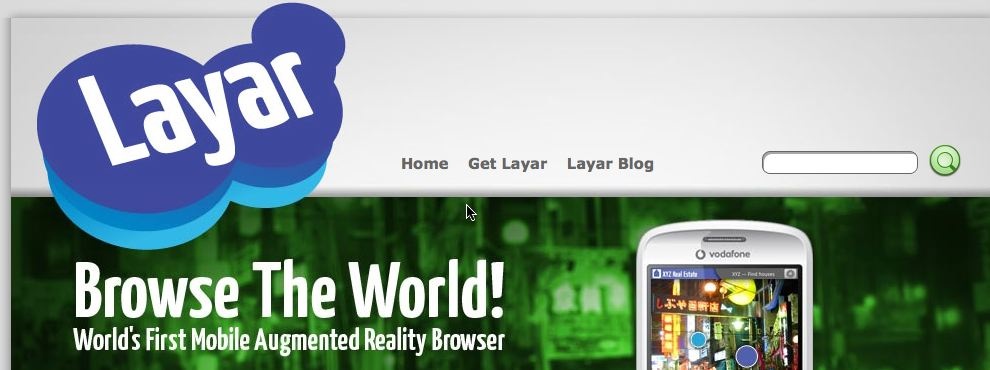
Combine GIS with mobile devices equipped with a digital compass and GPS and what do you get? Datascapes that can be mapped and layered on top of any object in the city, the potential for moving GIS and locational based services direct into the field is to be honest huge and now the first service has launched in the Netherlands via SPRXmobile. Known as Layar, it is the worlds first mobile Augmented Reality browser, which displays real time digital information on top of reality (of) in the camera screen of the mobile phone.

While looking through the phone’s camera lens, a user can see houses for sale, popular bars and shops, jobs, healthcare providers and ATMs. The first country to launch Layar is The Netherlands. Launching partners are local market leaders ING (bank), funda (realty website), Hyves (social network), Tempo-team (temp agency) and Zekur.nl (healthcare provider).


How it works

Layar is derived from location based services and works on mobile phones that include a camera, GPS and a compass. Layar is first avaliable for handsets with the Android operating system (the G1 and HTC Magic). It works as follows: Starting up the Layar application automatically activates the camera. The embedded GPS automatically knows the location of the phone and the compass determines in which direction the phone is facing. Each partner provides a set of location coordinates with relevant information which forms a digital layer. By tapping the side of the screen the user easily switches between layers. This makes Layar a new type of browser which combines digital and reality, which offers an augmented view of the world.

2008-07-08

Location Based Augmented Reality for Android: Enkin


Enkin from Enkin on Vimeo.


We have always been perplexed by companies building 3D cities for mobile devices as by nature of the device you are already in the city when using it and thus can just use your 'eyes' to look around. The same goes for maps, maps in cities are all well and good for getting from A-B but they fall down when you just want to know more local information at a building level.

What is needed then is a way to augment reality in real time - to geotag buildings and locations based on what you are seeing. This is exactly what the guys from Enkin have come up with running on Android (the open source mobile platform from Google).

The movie above explains all and in short we haven't been more excited about a location based service for a long time, the idea is genius. The system combines GPS, orientation sensors, 3D graphics, live video, several web services, and a novel user interface into an intuitive and light navigation system for mobile devices.

The often talked about augmented reality looks like it just got real...

See http://www.enkin.net/ for more info.

2007-11-13

Google's Android - Mobile Maps, Panoramas and Google Earth?

Android the uniquely named new open source operating system for mobile phones is intriguing. We like the open source nature and the tie in with Google allows easy use of their maps application along with the ability to view linked apps such as 'Street View'.

In the video below Sergey Brin and Steve Horowitz discuss the availability of the SDK and provide a walk through of some sample applications. Of note is the 'World Time' using a spinning earth via a touch screen interface - with the link to OpenGL could this be the first glimpse of a mobile Google Earth?


The SDK and more information can be found at http://code.google.com/android/

For an interesting take on Android take a look at Robert Scoble's Google's Android Wants Developers but...