CityDashBoard TalesofThings MapTube
Qrator Tutorials About Digital Urban
MRes ASAV SurveyMapper Contact Us

2005-01-13

Worlds within Worlds


Presenting panoramic images as a movie - ie without them being interactive - often proves difficult as it involves tedious video editing to allow seamless blends. It also tends to simply look like a standard movie, losing the concept of stitched images and photo globes.

Admittedly there is not often a need to show panoramas as movie clips, as they are meant to be interactive, but in our case we need to produce an illustration of moving between panoramas while retaining a sense of immersion.

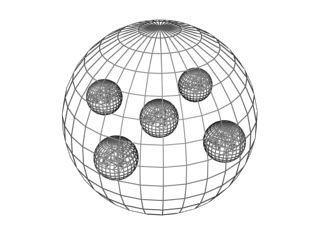
As such we have turned to thoughts previously part of the '30 Days in ActiveWorlds' research of 'Worlds within Worlds' (the concept is pictured above). Creating a series of 'Worlds within Worlds' alows a number of panoramas to be combined and 'stepped' into whenever the user wishes.
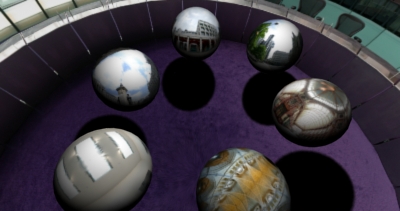


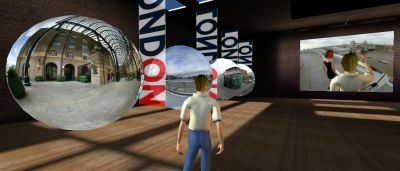
The images above and below illustrate a rough draft of this concept. Rendered in 3DMax we have a series of sub-worlds enclosed in the Greater London Authorities debating chamber.
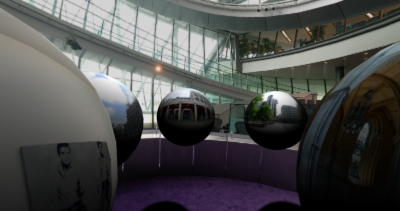


This allows a smooth camera path into and out of each panoramaic globe, illustrating the concept of interlinked scenes and immersion. The best way to understand the idea of 'Worlds within Worlds' is to view the draft movies via the links below, any comments would be most welcome.

The draft movie can be viewed here - highly optimised (14.7Mb, 7 minutes runtime) and here - high quality (63.9Mb, 7 minutes runtime). Note the movie uses the DIVX codec, details are on our main movie page

2005-01-07

Archos Capturing Research

.

Capturing aspects of research to place online has always been problematic. If your wanting to demonstrate software packages or work flows, the only option was screen capture technology such as SnagIt from TechSmith. Such solutions are not ideally suited to 3D applications due the processing power required, often resulting in captures with dropped frames and less then perfect movies.

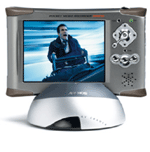
As such we have now moved to using the Archos AV400 (pictured above) which allows a direct connection to your computers graphics card and encodes to DIVX. DIVX encoding ensures compressed files at maximum quality and as its direct from your graphics card there are no issues about dropped frames.


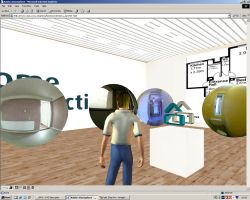
The image above illustrates a movie captured showing our Virtual Worlds research, recorded direct from the Archos the movie can be viewed online from

http://www.casa.ucl.ac.uk/olp/

2005-01-06

Adobe Atmosphere Discontinued


With the work on Virtual London moving forwards into an Adobe Atmosphere multi-user world, it comes as a bit of a surprise that Adobe have, as of 19th December 2004, closed down the product.

The main difference between Atmosphere and other multi-user worlds, such as 'Second Life' is the ability to import your own objects from 3DMax. Object import allowed realistic worlds to be created quickly and easily, all shared within an avatar based environment. Yet, after only one year of product development Atmosphere has been canned.

The software continues to run and you can publish, but Adobe have removed all the avatars from their site and shut down their server, leaving things a bit in the dark. There are ways around this and the Virtual London work will be published as planned, its just a shame that it looks like it will be one of the last Atmosphere worlds to go live.

In the past we have used a number of systems, from ActiveWorlds to Blaxxun, the question is where now? With funding to build mutli-user environments there is no one system that jumps out as a replacement to Atmosphere, time will tell where we go next.

R.I.P Atmosphere.. a movie of the work to date can be found on the main site http://www.casa.ucl.ac.uk/olp/